Back to Notes
What Managing a High-Ticket EdTech Website Taught Me About Indian Users — And What No One Talks About
I lead the product design for NIATIndia.com — a high-stakes EdTech platform where a single admission decision can cost a family several lakhs and involves months of research. I check the analytics every day. Here is everything I wish someone had told me earlier.
Introduction
Introduction
Introduction
There's a specific kind of humility you develop when you stare at behavior data long enough.
You start with assumptions — about who your users are, how they navigate, what they want. Then the data shows up and quietly dismantles most of them. Not dramatically. Just persistently, session after session, month after month.
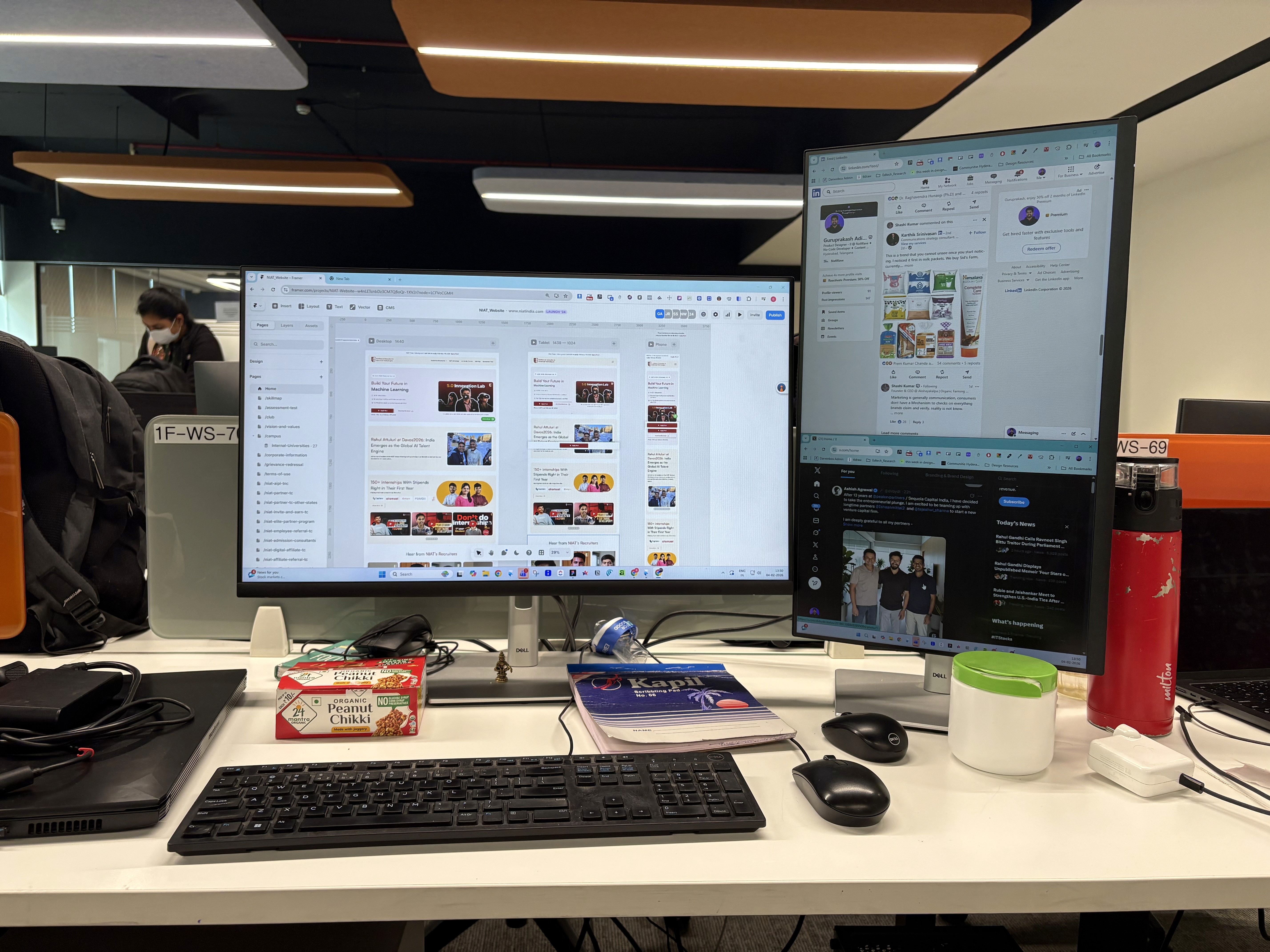
I've been the lead designer on a large-scale EdTech website in India for over three years. We use three tools simultaneously — Microsoft Clarity for behavioral data, Google Analytics 4 for acquisition and events, and Framer's built-in analytics for real-time signals and CTA tracking. Each one tells a part of the story. None of them tells the whole thing alone.
This is what I've learned.

One thing upfront: desktop numbers lie on EdTech websites

On our site — NIAT India — a significant chunk of that desktop traffic comes from inside. Sales teams walking prospective students through the site during counselling sessions. Designers and product folks like me opening it on laptops to check how something renders. This inflates desktop numbers and makes those sessions look more engaged than actual external visitors really are.
On our site, a meaningful chunk of that desktop traffic is internal. Sales teams, design team members, me and my colleagues opening the site on laptops to check how something looks. It inflates the desktop numbers. It affects engagement time. It makes desktop sessions look more engaged than they really are from external users.
The real story is mobile. Heavily. The actual external users — students, parents, curious visitors — are almost entirely on their phones. If you're running an EdTech website targeting Indian students, assume mobile is the primary experience and that everything else is secondary.
Design every decision for a student holding a phone with one hand on a moving bus. That's your real user.

The Indian admission journey is nothing like what UX playbooks describe

Every UX framework talks about a neat linear funnel. Awareness → consideration → conversion. Clean, sequential, predictable. The Indian college admission journey — especially for a programme like NIAT where fees run into several lakhs — is none of that. This is not a ₹99 webinar decision. This is a family financial commitment that can shape a student's next four years.

Here's what actually happens:
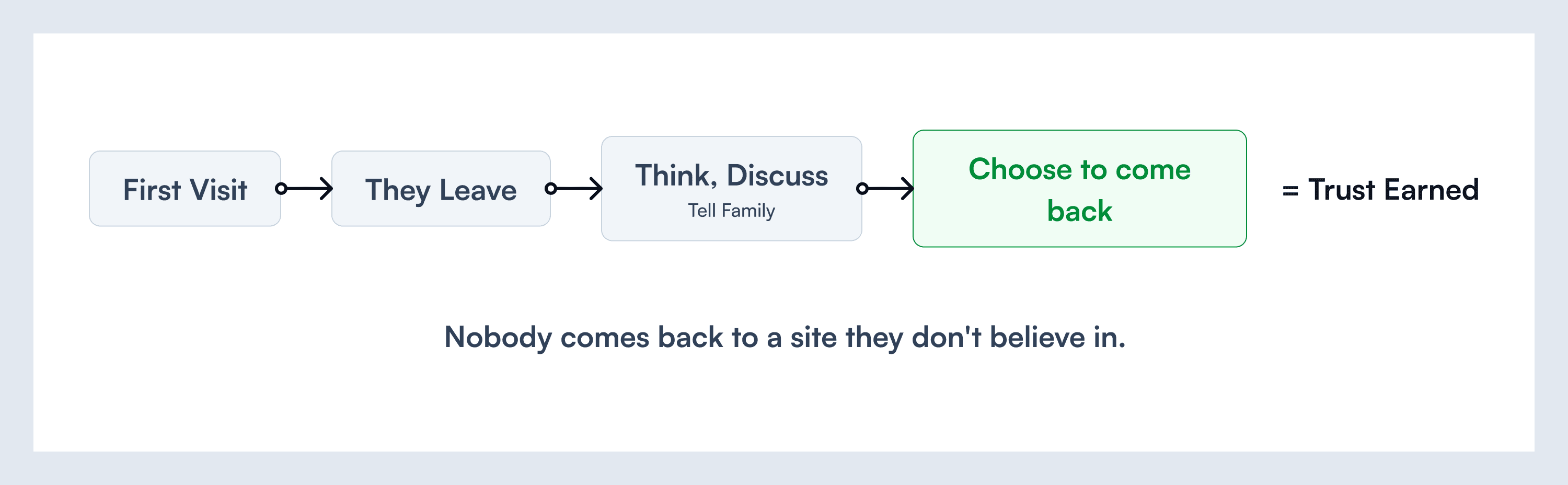
A student hears about NIAT — from a friend, a YouTube ad, a WhatsApp forward, a cousin who studied there. They do a quick mobile search, land on the site, look for maybe 30–40 seconds, and leave. No conversion. Bounce rate says failure. But they weren't ready to convert. They were filing us away.
Days later, they come back. They browse the campus page. They check the fees page. They read student achievements. They leave again.
Then they tell their parents. And because the fee is not small — we're talking about a programme that costs more than most Indian families spend on anything outside of property or a wedding — the parent's involvement is not optional. It's mandatory. The parent is not a secondary stakeholder. They are often the final decision maker.
And then their father opens the site on a desktop computer — or maybe on his own phone — and looks at it through a completely different lens. Less "is this cool" and more "is this legitimate, is this worth the money, what are the outcomes?"
Only after this multi-visit, multi-person, multi-device process does any action happen.
I've watched this pattern emerge across NIAT's session data, return visit rates, and the growing share of returning users. The site that treats every visit as an independent conversion opportunity will fail this user. The site that builds trust across multiple touchpoints — for the student, for the parent, for the relative who gets sent the link on WhatsApp — that site wins. At this price point, trust is not a nice-to-have. It is the product.
What the traffic curve actually means for designers?
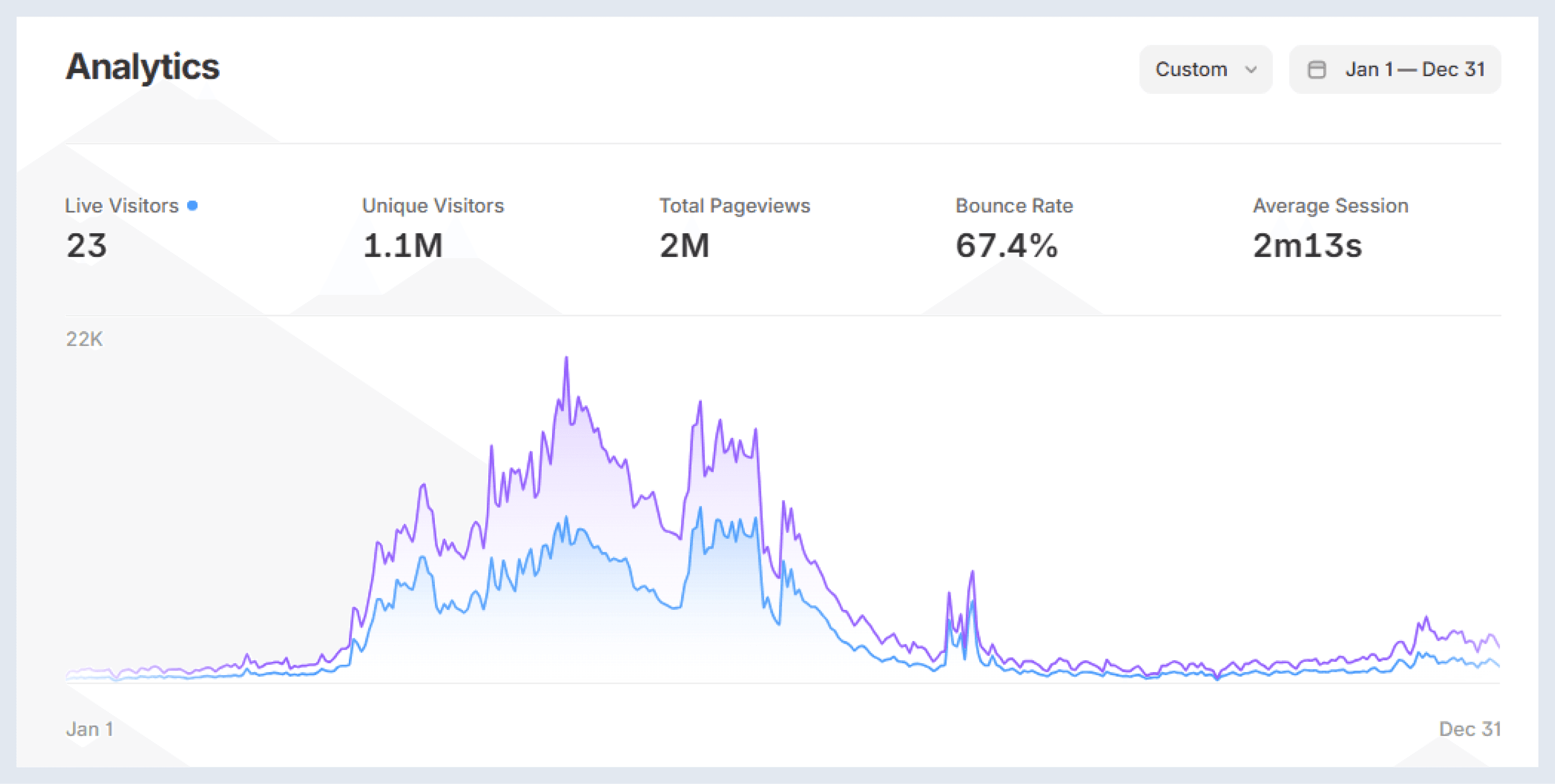
EdTech traffic in India doesn't flow evenly across the year. It erupts.
The April–May window — India's college admission season — drives traffic that can be three to four times the year-end baseline. JEE results come out. Board results come out. Families start making decisions. Everyone is on your site at once.
Then it drops. Hard. August brings a smaller second pulse — the back-to-college cycle — and then it settles into a quiet baseline for the rest of the year.
Most teams treat this as a traffic insight. I treat it as a design calendar.
Here's the rule I now follow: ship nothing risky in April or May. If a feature, a redesign, or even a significant copy change is not stable and tested by March, it waits until June. The highest-traffic window is not the time to be experimenting. It's the time to harvest.
This means your actual design roadmap should look like this: build and iterate in Q3, stabilise and optimise in Q4, prepare for peak in Q1, defend in Q2. Working backwards from the season, not forwards from the sprint.

Students scroll. Parents read. These are not the same visit.

This is the insight I keep coming back to.
Across all the behavioral data I've analyzed, scroll is the dominant event by a large margin. It makes up nearly half of all tracked events on the site. Users are readers. They scroll through content linearly, top to bottom, looking for the thing that answers their question.
But what they're scrolling for depends entirely on who they are.
A student scrolling the site is looking for: does this look legible? does it look modern? do students my age go here? is there something exciting about this place? They're running a vibe check. They decide in seconds whether this deserves a longer look.
A parent reading the site is asking completely different questions: is this real? is this accredited? what happens after graduation? what are the fees and is there a payment plan? who are the faculty? This is a financial and reputational evaluation. They need specificity, not aesthetics.
The challenge is that both of them are often arriving on the same pages. You cannot design a different page for each of them. But you can design a page that layers information — surface-level impressions for the quick mobile scroll, deep verifiable specifics for the research-mode desktop reader.
This is not about having more content. It's about sequencing content strategically. Lead with signal. Support with proof. End with action.

The pages users visit reveal the two questions they're actually asking
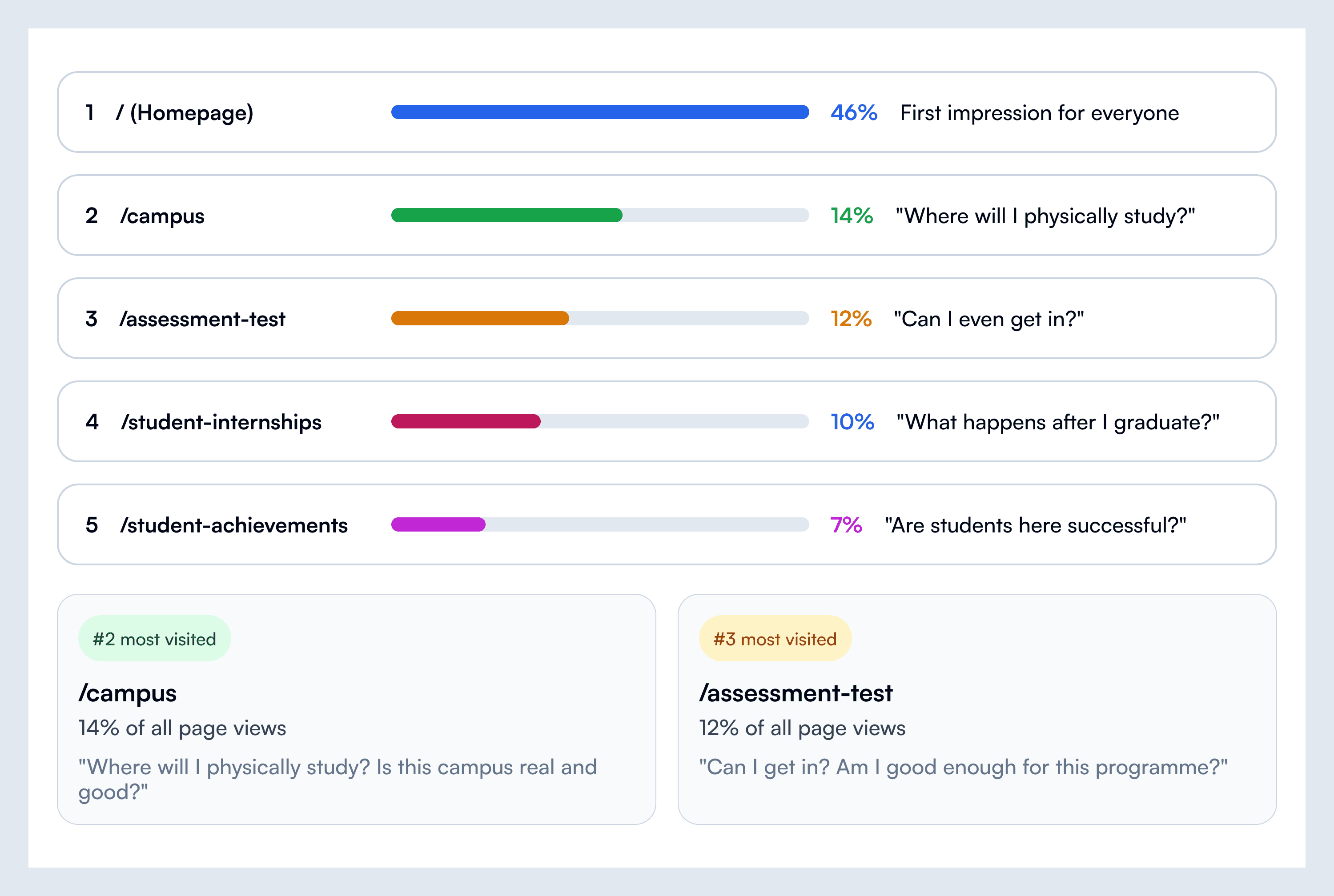
After the homepage, the two most visited pages tell you everything about what Indian students and parents actually care about when evaluating an EdTech programme.
First: the campus page. Students want to know where they will physically go. This is not a metaphor. In India, the physical campus is enormously important to both students and parents. It's a status signal. It's proof that this is a real institution and not a laptop course. It communicates the social environment — "people like me study here." When this page grew massively in a single month, it wasn't random. Admission season was intensifying and the campus question was becoming urgent.
Second: the assessment test page. This tells you that students are self-qualifying before they apply. They want to know: can I pass this? am I good enough for this programme? This is a very Indian instinct — evaluation before commitment. Students don't want to be rejected. They want to pre-assess their chances. A well-designed assessment page doesn't just describe the test. It reduces the fear of trying.
Both of these pages existed in our information architecture as deep navigation items — several clicks from the homepage. The analytics showed us they were actually the second and third most important pages on the site. We redesigned the homepage navigation and the campus page's conversion path based entirely on this.
Your most visited pages after the homepage are telling you which questions your users haven't had answered yet. Listen to them.

Returning users are the truest signal that something is working
When I started, the site's session mix was heavily dominated by new users. Most sessions were first visits. Over time, as we improved the content quality, the UX, and the trust signals — that ratio started shifting.
The most recent data shows returning users at near-parity with new users. That shift — from a mostly-new-user site to a nearly-equal returning-user site — is the single most meaningful brand-building trend in the analytics.
It means people are coming back. It means the first visit created enough of an impression that they returned. It means a family discussion happened and the site survived the "show me what you found" moment.
In one observed month on NIAT, returning user sessions surged by over a third. That's not a traffic campaign doing that. That's families coming back — students showing parents, parents doing their own research, cousins checking before giving advice. Something in the product earned that second visit. That's the signal worth obsessing over.
If your returning user rate is low, no CTA redesign will save you. You have a content and trust problem, not a conversion problem.

Frustration signals are how users tell you something is broken — without saying a word
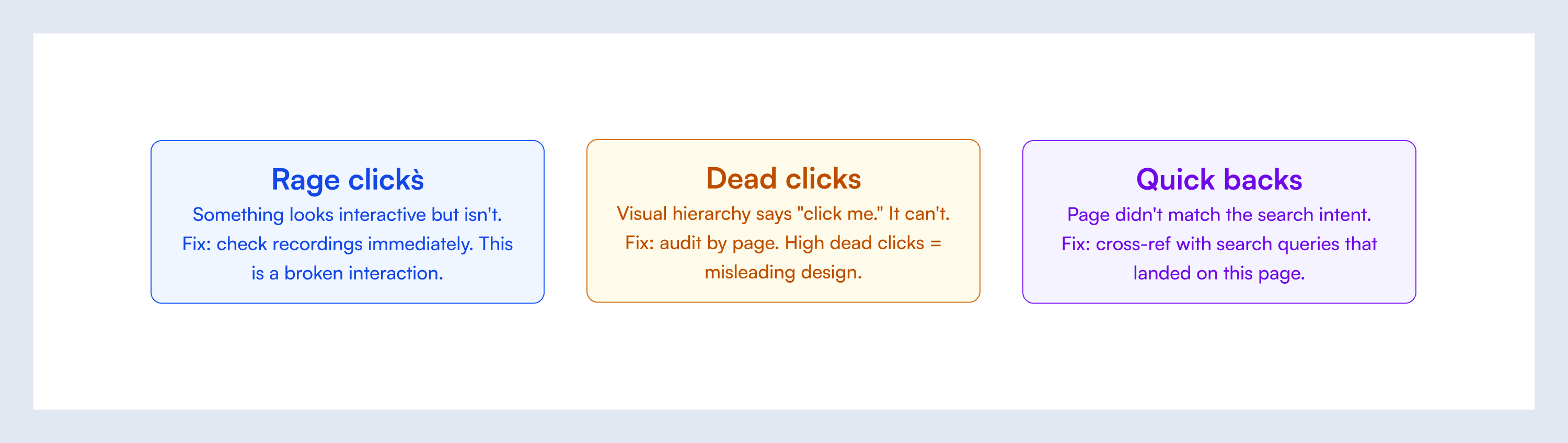
Clarity's three frustration signals are not equally urgent. I've learned to read them at different speeds.
Rage clicks demand immediate attention. They're rare — under 0.2% on a healthy site — but when they spike on a specific page, something is visually broken. A button that appears clickable but isn't responding. A form field that freezes. Open Clarity recordings filtered to that page within 24 hours. Don't wait for a bug report.
Dead clicks are chronic, not acute. Users clicking on decorative images expecting them to enlarge. Text that looks like a link but isn't. Images arranged to look interactive. The right response is a quarterly page audit, not a panic. But a specific page with suddenly high dead clicks is telling you that something on that page is lying to users visually.
Quick backs are philosophically different from the other two. A user who quick-backs isn't frustrated by the page — they're frustrated by the mismatch between what the search result promised and what the page delivered. This is an SEO-UX alignment problem. The fix lives in your page titles, meta descriptions, and above-the-fold content — not in the CTA.
One pattern specific to returning users that I want to flag: quick-back rates tend to rise as the proportion of returning users grows. That's not a problem. Returning users navigate more aggressively — they go back to pages they've already seen because they're comparing. High quick-backs among a loyal returning audience is healthy behavior. Don't panic at the number without understanding who's producing it.

Where traffic actually comes from — and the shift nobody is talking about
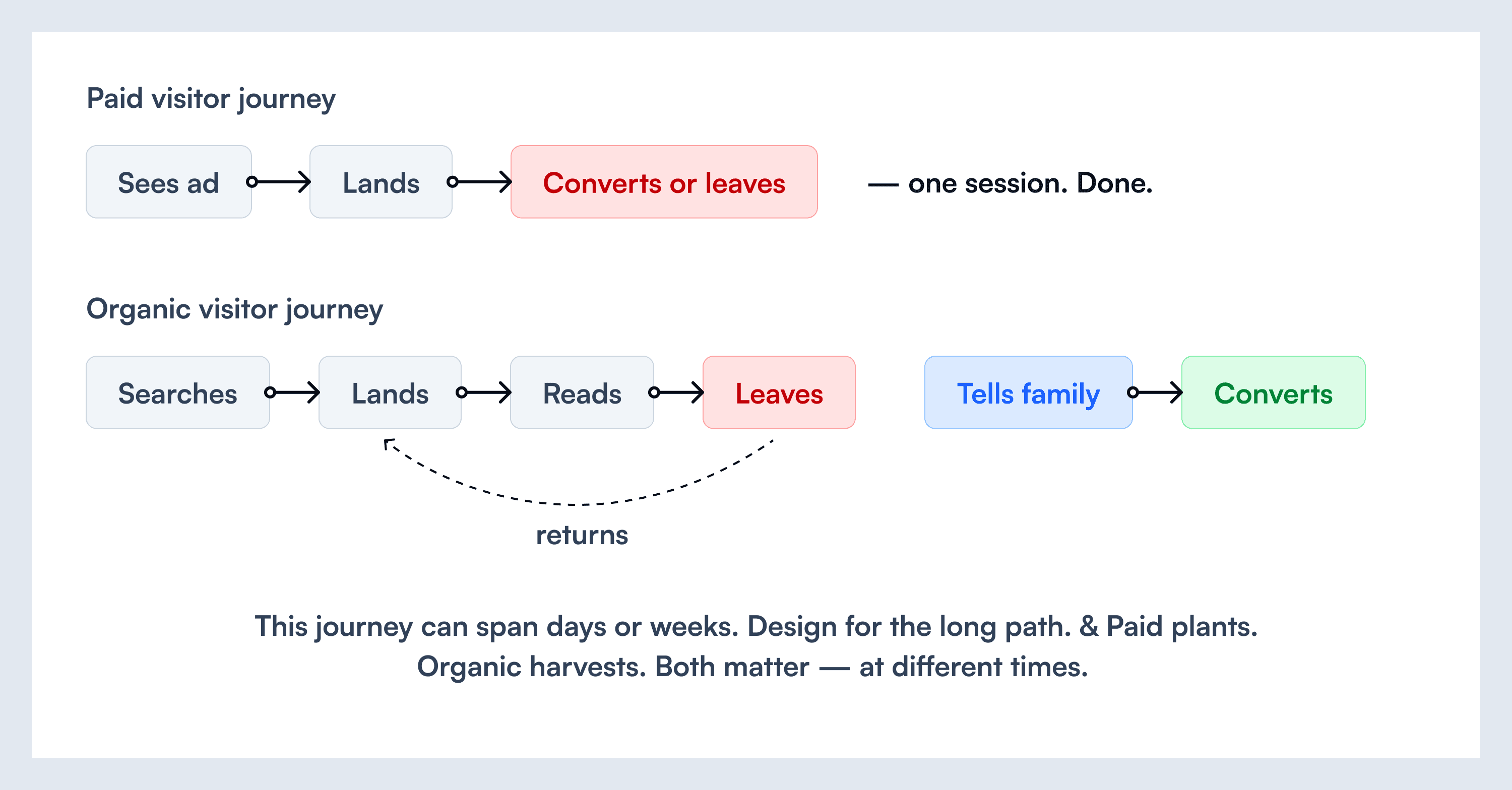
When the site ran heavy paid campaigns, almost a third of all sessions came from paid channels. The acquisition mix looked balanced between organic and paid.
Then paid spend reduced significantly. And something interesting happened: organic traffic didn't drop. It grew. Direct traffic grew too — which means people who'd been introduced via campaigns were now coming back on their own, searching the brand name or typing the URL directly.
The paid investment had planted seeds. The organic landscape was harvesting them.
But here's the design implication that most people miss: paid visitors and organic visitors are completely different users with completely different mindsets.
A paid visitor arrived because an ad interrupted them and made a specific promise. They arrive with high expectations and low patience. If your landing page doesn't immediately deliver the thing the ad promised, they leave. They don't explore. They evaluate and exit.
An organic visitor arrived because they went searching for something. They have intent. They're willing to read. They're more likely to scroll, explore, and come back.
Designing the same homepage for both audiences is a compromise that serves neither well. When you know your acquisition mix is shifting, your landing page strategy needs to shift with it.

The event that changed our thinking about content strategy

One month, a new event page appeared — Makers Conclave — and within weeks it became one of the most visited pages on the entire site. It came out of nowhere and then generated enormous traffic from organic search, social sharing, and direct links.
It taught us three things.
First: event-driven content is a traffic accelerant. A well-executed event page can drive more traffic in a single month than a programme page accumulates in a year. Events are real, time-bound, and shareable. They create urgency. They generate press. They travel on WhatsApp.
Second: you have to convert that traffic while you have it. Once the event passes, the page goes cold. The students and parents who visited it during peak interest are gone. The page needs email capture, sign-up prompts, or at minimum a follow path to another relevant page — the moment someone is on an event page is a high-attention moment. Don't waste it with a dead end.
Third: the campus page doubling in traffic in the same month was not a coincidence. The event brought people onto the site. Once they were there, they explored. That's the compound benefit of creating content reasons to visit — the attention you earn on one page flows to others. Internal linking from event pages to programme pages and campus pages is not a nice-to-have. It's a conversion architecture decision.

What the "scroll is 46% of events" number actually means for designers
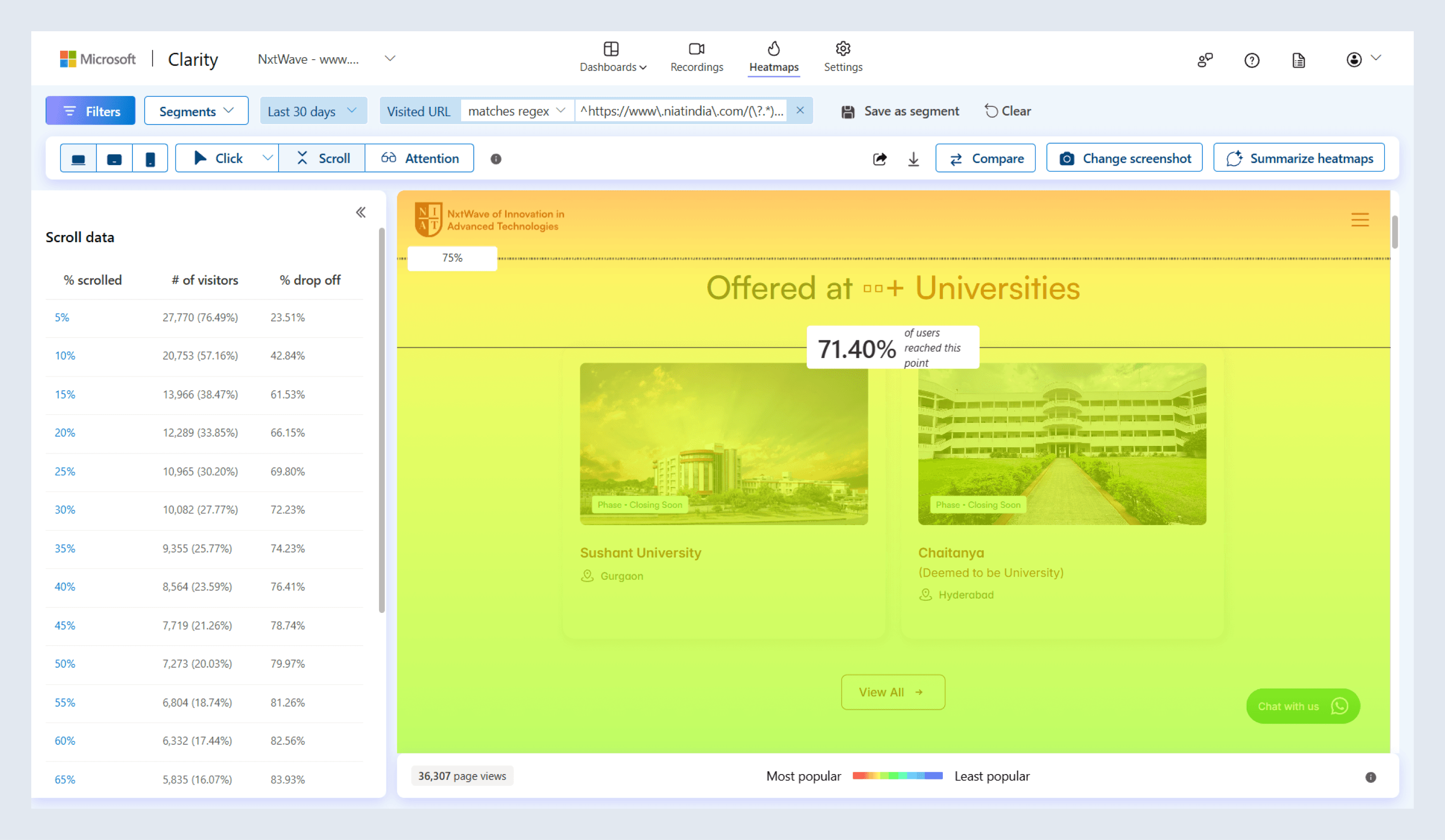
Almost half of all events on the site are scroll events. Think about what that means.
Users are not primarily clicking around. They are reading. They are moving through content linearly. The site, in behavioral terms, functions more like a long-form article than an interactive app.
This has real implications for how you design pages. More implications than most designers draw from it.
It means every section is auditionable. As a user scrolls, each block of content gets roughly the same amount of attention time. None of them is guaranteed to be read. All of them need to justify their presence by answering a question the user is likely to have at that point in their scroll journey.
It means wall-of-text sections kill momentum. Even on a reading-mode site, dense unbroken text causes users to slow, skim, and eventually abandon. Short paragraphs. Clear section headers. Visual breaks. These aren't aesthetic preferences — they're engagement tools backed by behavioral data.
And here's the one that surprised me most: video progress events fire at roughly 10 times per session for users who engage with video at all. That's an extraordinary depth ratio. Users who start watching videos watch multiple ones, deeply. If you have strong video content on your site, treat it as a primary experience, not a sidebar supplement. Put it where users will actually find it during their scroll journey.

The retention curve and why it should stop scaring you
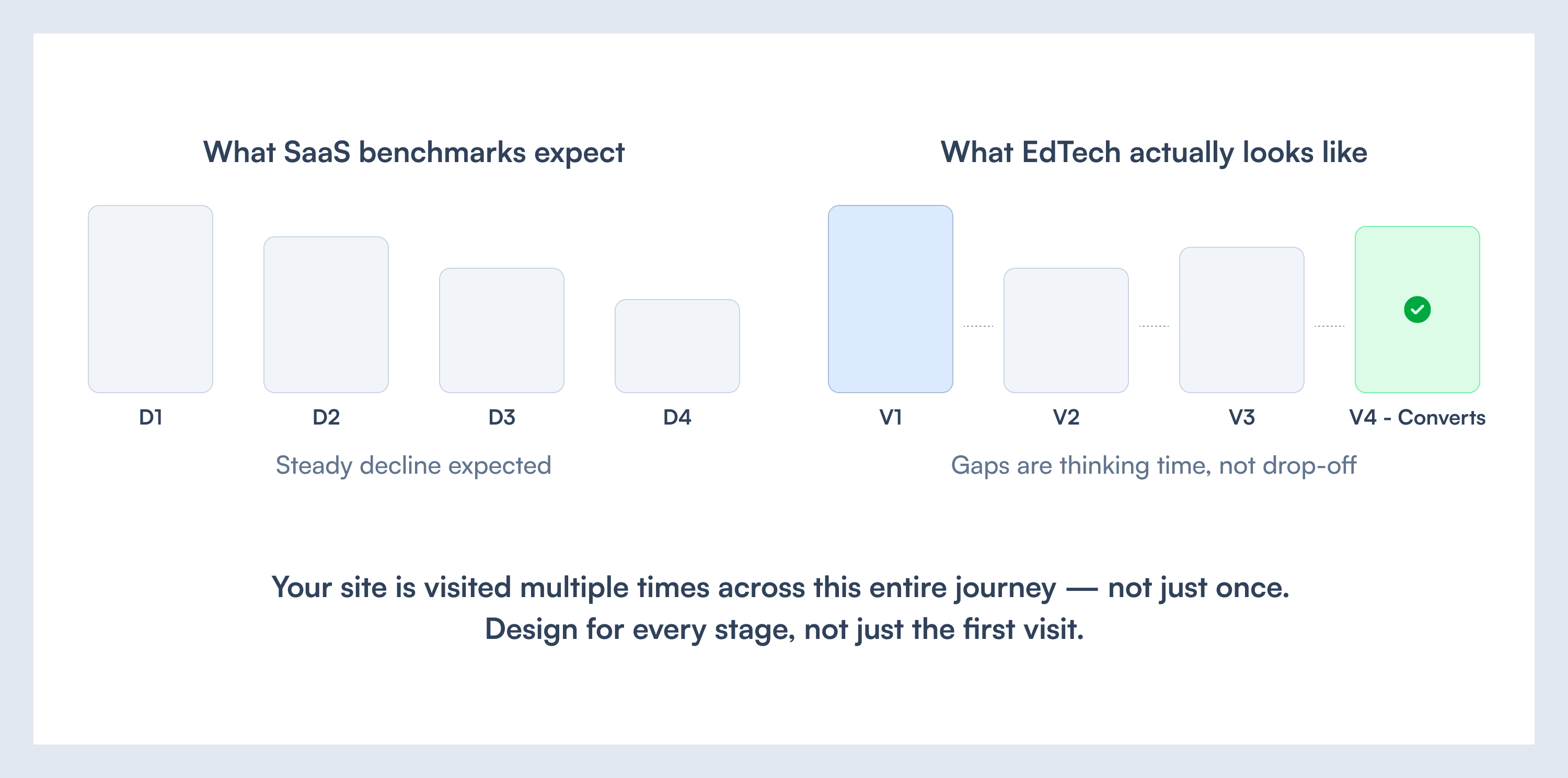
When I first looked at the retention curves, my instinct was alarm.
Day 1 retention at 3.7%. Day 7 at 1.9%. Day 30 at 0.3%. Compared to SaaS benchmarks or consumer app norms, these numbers look catastrophic.
Then I reframed the question: what does the consideration journey for a major educational decision actually look like in India?
A family doesn't decide on a college programme in a day. Or even a week. The process involves the student's own research, a conversation with parents, comparison with 2-3 other options, discussion with relatives who went to similar institutions, and often a visit to the campus. This entire journey can span weeks.
The metric that actually matters for this product is not day-1 retention. It's weekly active users as a share of monthly active users — the WAU/MAU ratio. For this site, roughly a third of monthly visitors return within the same week. That means active, ongoing consideration. That means the decision is in progress. That's the signal worth designing for.
What does designing for this look like? It means every page needs to give someone a reason to come back. New content. Updated placement information. A downloadable resource. A comparison tool. Something that rewards the second and third visit rather than assuming conversion on the first.

The thing I got wrong for the first six months
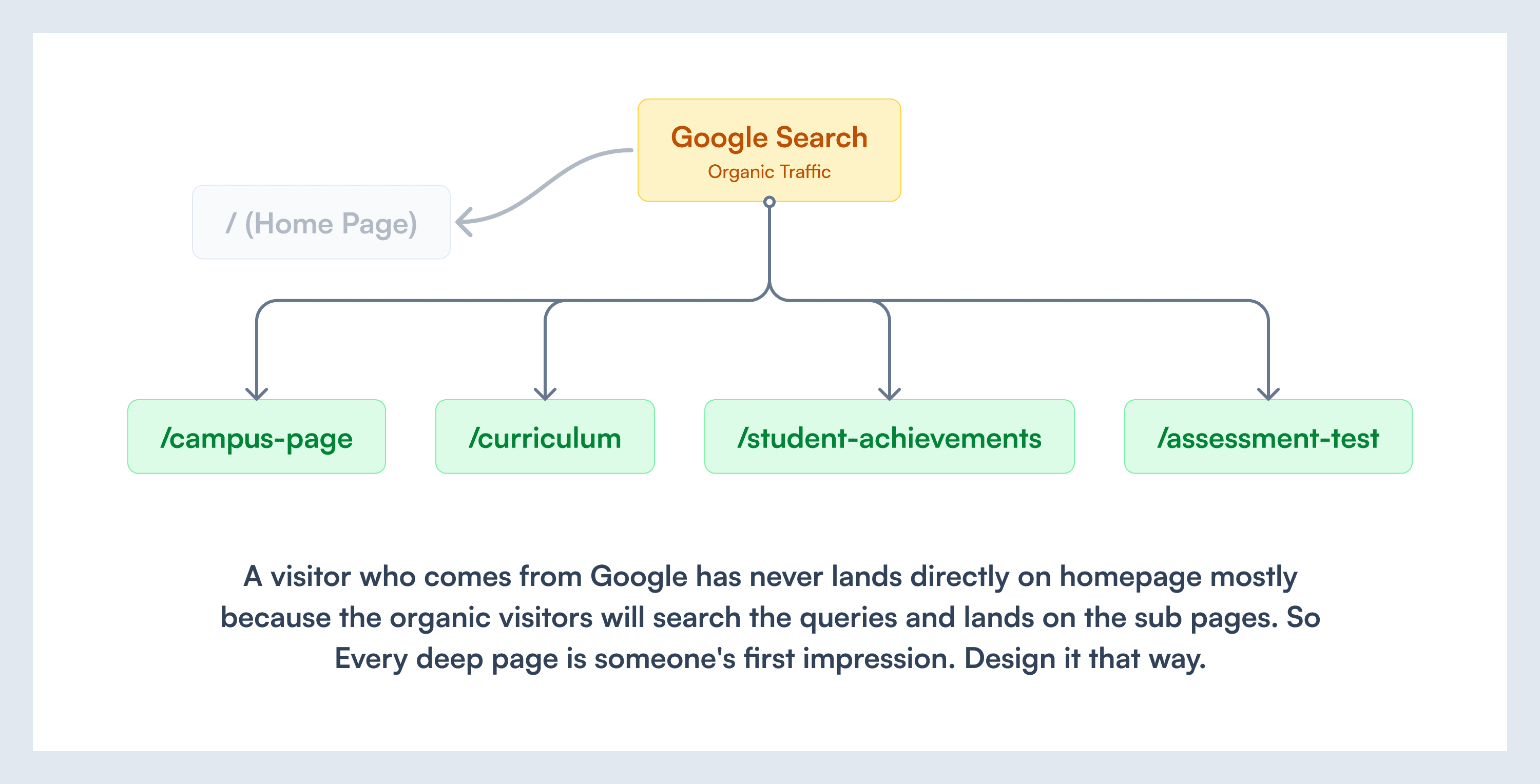
I treated the homepage like it was everyone's entry point. I spent disproportionate design effort optimising the homepage experience, the hero section, the first-fold hierarchy.
The analytics eventually showed me that a very significant portion of sessions were landing directly on deep pages — the campus page, the AI Bootcamp programme page, event pages, the assessment test page — often from organic search. These users never saw the homepage. Their first impression of the brand was whatever page Google served them.
Every one of those pages needs to work as a complete, standalone first impression. Not a page that assumes context from the homepage. Not a page that expects users to have read the "About" section first. A page that introduces the brand, establishes legitimacy, communicates the value, and provides a clear next step — all within 30 seconds of landing.
I now run what I call a fresh-eyes audit on every high-traffic landing page regularly: open it in an incognito window, pretend I know nothing about the product, and answer three questions in 30 seconds.
What is this? Is it for me? What should I do next?
Every page that fails any of those three questions gets added to the redesign queue. It's the most consistently useful design practice I've adopted from analytics.

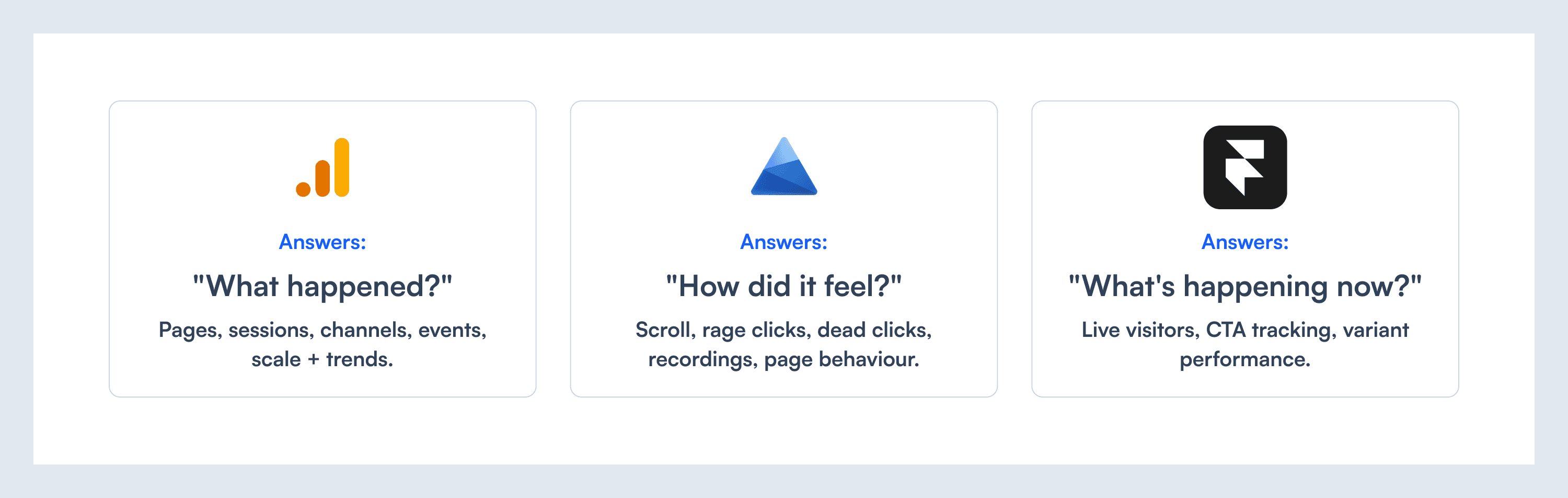
The three tools are not redundant. They're complementary in a very specific way.
This is worth saying clearly because most teams pick one analytics tool and call it done.
GA4 tells you what users did — which pages they visited, how many sessions, which channels sent them, how events accumulated across sessions. It's excellent at scale and longitudinal trends.
Clarity tells you how users behaved — where they scrolled, what they clicked, where they raged, how the page felt. It's excellent at diagnosing specific pages and flows.
Framer analytics tells you what's happening right now, and specifically how named CTAs and tracking elements are performing — not just that someone visited a page, but whether they clicked the specific variant of a button you're testing.
The combination is irreplaceable. GA4 tells you a page has a high bounce rate. Clarity tells you users are actually scrolling deeply before leaving. Framer tells you the CTA on that page isn't getting clicks. Together: the page earns attention but fails to convert it. The specific problem is the CTA, not the content.
Any one tool alone would have told you something different and less useful.

Where this is all heading — and what it means for EdTech design
The EdTech article I read alongside building this analysis makes an argument I find compelling: Indian EdTech is coming out of a hype cycle and entering an infrastructure phase. The big VC-fuelled growth-at-all-costs model is correcting. What's left is the actual educational value, the actual placement outcomes, the actual experience of being a student.
For designers, this is clarifying.
When the hype cycle is running, growth metrics dominate. Traffic. Sign-ups. Paid conversions. You design for acquisition.
When the infrastructure phase arrives, trust metrics dominate. Returning users. Engagement depth. Completion rates. Reviews. Word-of-mouth. You design for retention and credibility.
The analytics shift I've watched — from paid-heavy, new-user-dominant traffic to organic, returning-user-growing traffic — is this transition happening in real time on our site.
The users who matter most to NIAT's long-term success aren't the ones who clicked an ad. They're the student who came back three times before filling the form. The father who opened niatindia.com on his laptop on a Sunday evening and forwarded it to the family group. The cousin who said "I checked it, it looks legit." None of those moments can be bought. Every single one had to be earned — through content that answered real questions, pages that didn't feel suspicious, and a site that held up under family scrutiny.
Those users can't be bought. They can only be earned.
That's what three years of analytics on NIATIndia.com taught me. Not traffic numbers or bounce rates. That when families are making a decision that costs several lakhs and shapes four years of a student's life — the design problem is trust. Earn it consistently, across multiple visits, for every person in the family who will eventually see that link. Everything else — the CTAs, the hero sections, the A/B tests — is downstream of that one thing.
Everything else is downstream of that.
Conclusion
Conclusion
Conclusion
I lead product design for NIATIndia.com and have been working on it for three years. NIAT is a high-ticket EdTech platform where families make multi-lakh decisions about their children's education. I use Microsoft Clarity, Google Analytics 4, and Framer analytics daily. If you work on EdTech, admissions platforms, or large-scale consumer websites and want to compare notes — I'm always open to that conversation.
Want to work together?
Feel free to reach out for collaborations, inquiries, or just to say hello.
Want to work together?
Feel free to reach out for collaborations, inquiries, or just to say hello.
Want to work together?
Feel free to reach out for collaborations, inquiries, or just to say hello.
Let's Be Friends
Feel Free to Hit Me Up!
I always enjoyed product discussions and If you’re a startup founder or PM/Growth person and interested to chat! Hit me up on any social media platforms.

Crafted with ❤️ on Framer, All Rights Reserved © 2026 Guruprakash.
Let's Be Friends
Feel Free to Hit Me Up!
I always enjoyed product discussions and If you’re a startup founder or PM/Growth person and interested to chat! Hit me up on any social media platforms.

Crafted with ❤️ on Framer, All Rights Reserved © 2025 Guruprakash.
Let's Be Friends
Feel Free to Hit Me Up!
I always enjoyed product discussions and If you’re a startup founder or PM/Growth person and interested to chat! Hit me up on any social media platforms.

Crafted with ❤️ on Framer
All Rights Reserved © 2025 Guruprakash.