Back to Notes

How We Used Framer to Run A/B Testing on the NIAT Website

How We Used Framer to Run A/B Testing on the NIAT Website

How We Used Framer to Run A/B Testing on the NIAT Website

A case study in pre-peak experimentation, cross-domain tracking, and data-driven design decisions

A case study in pre-peak experimentation, cross-domain tracking, and data-driven design decisions

A case study in pre-peak experimentation, cross-domain tracking, and data-driven design decisions

What is A/B Testing?

What is A/B Testing?

What is A/B Testing?

A/B testing is the practice of simultaneously serving two different versions of a webpage to different segments of your audience, then measuring which version drives better outcomes. For a high-traffic website like ours, even a 2–3% improvement in conversion rate compounds into hundreds of additional leads — making it one of the highest-leverage tools available to a product designer.

A/B testing is the practice of simultaneously serving two different versions of a webpage to different segments of your audience, then measuring which version drives better outcomes. For a high-traffic website like ours, even a 2–3% improvement in conversion rate compounds into hundreds of additional leads — making it one of the highest-leverage tools available to a product designer.

A/B testing is the practice of simultaneously serving two different versions of a webpage to different segments of your audience, then measuring which version drives better outcomes. For a high-traffic website like ours, even a 2–3% improvement in conversion rate compounds into hundreds of additional leads — making it one of the highest-leverage tools available to a product designer.

A little context about me and the NIAT website

A little context about me and the NIAT website

A little context about me and the NIAT website

I am the design owner for the NIAT Marketing Team POD at NxtWave. Every task that comes from the marketing team to our pod goes through me — I am responsible for ensuring it is delivered properly, on time, and with the right quality. That means I coordinate across designers, developers, and stakeholders, and I take direct ownership of anything that sits at the intersection of design and implementation.

I am the design owner for the NIAT Marketing Team POD at NxtWave. Every task that comes from the marketing team to our pod goes through me — I am responsible for ensuring it is delivered properly, on time, and with the right quality. That means I coordinate across designers, developers, and stakeholders, and I take direct ownership of anything that sits at the intersection of design and implementation.

I am the design owner for the NIAT Marketing Team POD at NxtWave. Every task that comes from the marketing team to our pod goes through me — I am responsible for ensuring it is delivered properly, on time, and with the right quality. That means I coordinate across designers, developers, and stakeholders, and I take direct ownership of anything that sits at the intersection of design and implementation.

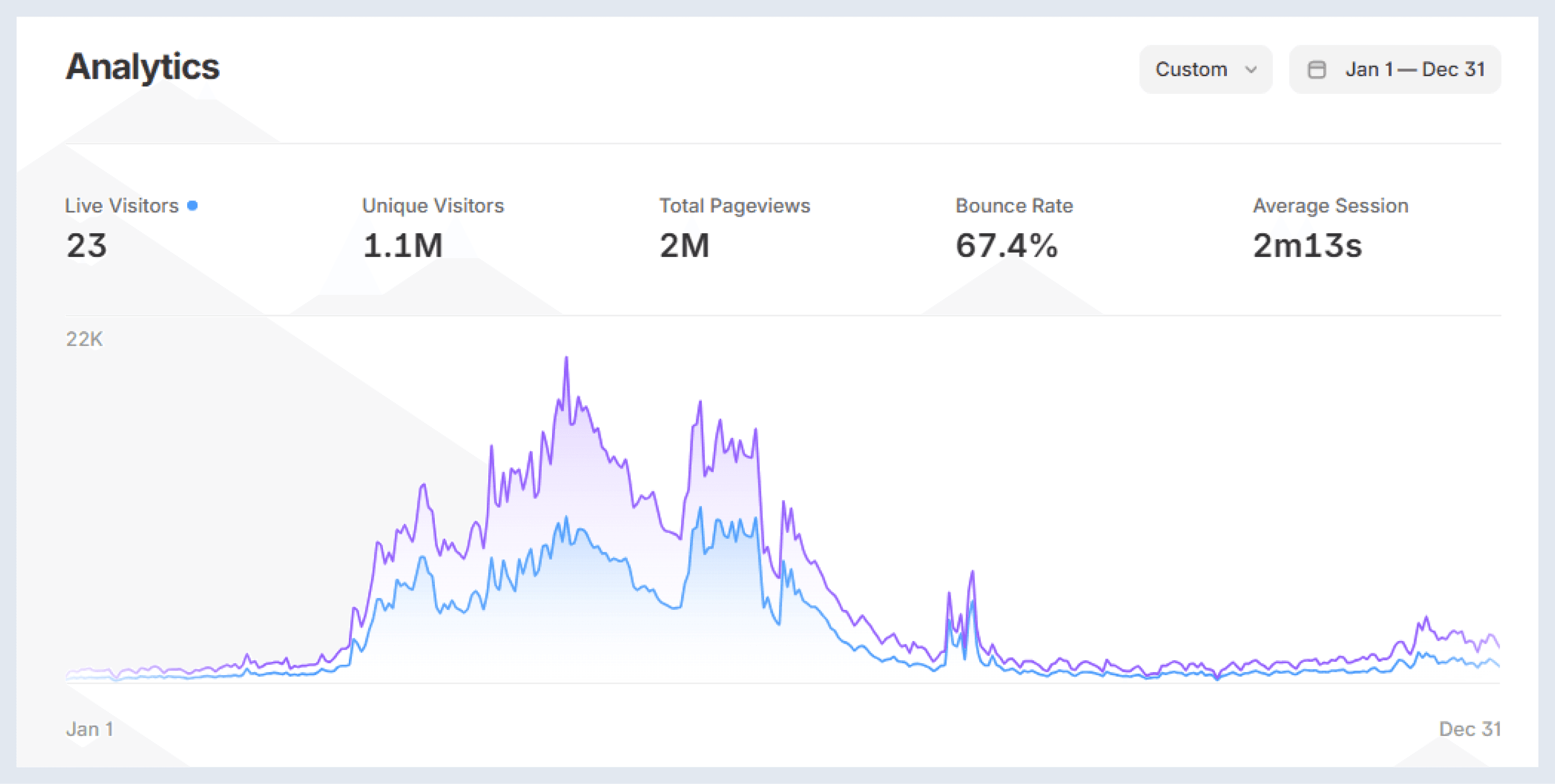
The NIAT website — niatindia.com — is one of our most critical digital products. I have been managing its design, development, and publishing for over two years. In 2025, the site recorded over 1.1 million unique visitors, 2 million total pageviews, and an average session duration of 2 minutes 13 seconds, all tracked via Framer's native analytics. That's the scale at which every design decision has a measurable consequence.

The NIAT website — niatindia.com — is one of our most critical digital products. I have been managing its design, development, and publishing for over two years. In 2025, the site recorded over 1.1 million unique visitors, 2 million total pageviews, and an average session duration of 2 minutes 13 seconds, all tracked via Framer's native analytics. That's the scale at which every design decision has a measurable consequence.

The NIAT website — niatindia.com — is one of our most critical digital products. I have been managing its design, development, and publishing for over two years. In 2025, the site recorded over 1.1 million unique visitors, 2 million total pageviews, and an average session duration of 2 minutes 13 seconds, all tracked via Framer's native analytics. That's the scale at which every design decision has a measurable consequence.

At NxtWave, we use Framer as our primary tool for marketing websites. Webinars, events, and our flagship products — NIAT, GRIT NIAT, NxtWave Launchpad — are all built, managed, and published in Framer. It gives us the design flexibility of a creative tool with the publishing infrastructure of a CMS.

At NxtWave, we use Framer as our primary tool for marketing websites. Webinars, events, and our flagship products — NIAT, GRIT NIAT, NxtWave Launchpad — are all built, managed, and published in Framer. It gives us the design flexibility of a creative tool with the publishing infrastructure of a CMS.

At NxtWave, we use Framer as our primary tool for marketing websites. Webinars, events, and our flagship products — NIAT, GRIT NIAT, NxtWave Launchpad — are all built, managed, and published in Framer. It gives us the design flexibility of a creative tool with the publishing infrastructure of a CMS.

The traffic reality: why timing everything matters
The traffic reality: why timing everything matters

The traffic reality: why timing everything matters

The NIAT website follows a very clear seasonal traffic pattern. Traffic starts climbing in March as Intermediate board results approach across states, peaks through April–June, and gradually comes down after August once the admission cycle winds down. The rest of the year is comparatively quiet.

The NIAT website follows a very clear seasonal traffic pattern. Traffic starts climbing in March as Intermediate board results approach across states, peaks through April–June, and gradually comes down after August once the admission cycle winds down. The rest of the year is comparatively quiet.

The NIAT website follows a very clear seasonal traffic pattern. Traffic starts climbing in March as Intermediate board results approach across states, peaks through April–June, and gradually comes down after August once the admission cycle winds down. The rest of the year is comparatively quiet.

This seasonality is critical context for everything that follows. Peak season is when the stakes are highest — the most visitors, the most registrations, the most revenue impact from any conversion rate improvement. It is also the worst time to be running experiments, because if something underperforms, the cost is enormous.

This seasonality is critical context for everything that follows. Peak season is when the stakes are highest — the most visitors, the most registrations, the most revenue impact from any conversion rate improvement. It is also the worst time to be running experiments, because if something underperforms, the cost is enormous.

This seasonality is critical context for everything that follows. Peak season is when the stakes are highest — the most visitors, the most registrations, the most revenue impact from any conversion rate improvement. It is also the worst time to be running experiments, because if something underperforms, the cost is enormous.

So we made a deliberate decision: experiment in January 2026, before the peak begins, so the winning variant is proven and ready when March traffic arrives.

So we made a deliberate decision: experiment in January 2026, before the peak begins, so the winning variant is proven and ready when March traffic arrives.

So we made a deliberate decision: experiment in January 2026, before the peak begins, so the winning variant is proven and ready when March traffic arrives.

This is the article about that experiment.

This is the article about that experiment.

This is the article about that experiment.

The Problem Statement
The Problem Statement

The Problem Statement

The marketing team came to our pod with specific data-backed problems they needed design to solve. This is the brief they shared:

The marketing team came to our pod with specific data-backed problems they needed design to solve. This is the brief they shared:

The marketing team came to our pod with specific data-backed problems they needed design to solve. This is the brief they shared:

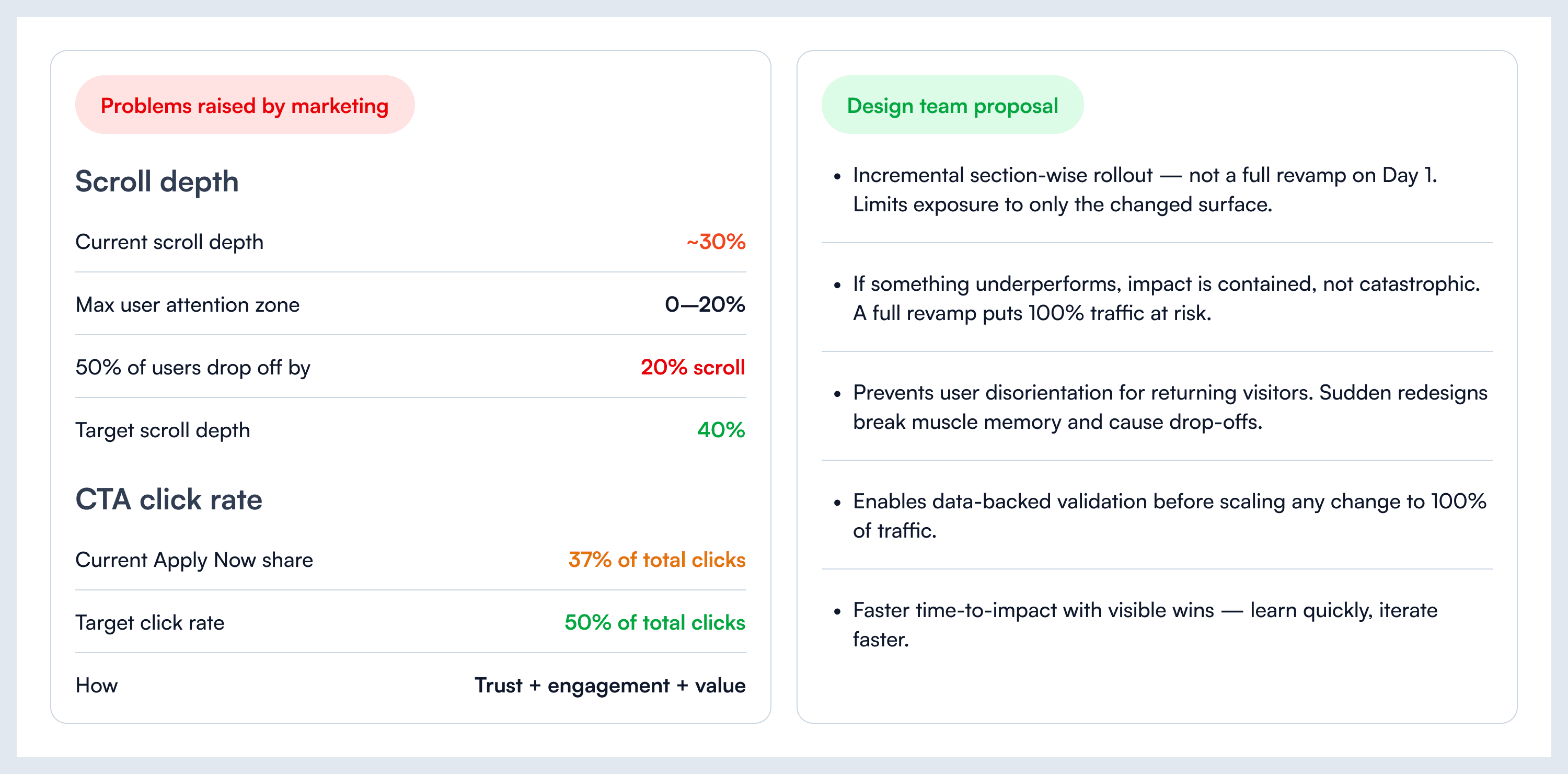
The numbers told a clear story. Users were barely scrolling — the current page depth was only ~30%, and 50% of users were dropping off by the 20% scroll mark. Most user attention was concentrated in the top 0–20% of the page. Beyond the scroll problem, only 37% of total clicks were going to the Apply Now CTA — the most important button on the page. The team wanted that number at 50%.

The numbers told a clear story. Users were barely scrolling — the current page depth was only ~30%, and 50% of users were dropping off by the 20% scroll mark. Most user attention was concentrated in the top 0–20% of the page. Beyond the scroll problem, only 37% of total clicks were going to the Apply Now CTA — the most important button on the page. The team wanted that number at 50%.

The numbers told a clear story. Users were barely scrolling — the current page depth was only ~30%, and 50% of users were dropping off by the 20% scroll mark. Most user attention was concentrated in the top 0–20% of the page. Beyond the scroll problem, only 37% of total clicks were going to the Apply Now CTA — the most important button on the page. The team wanted that number at 50%.

The brief was: redesign the homepage in a way that gets more people to click Apply Now, earlier in their visit.

The brief was: redesign the homepage in a way that gets more people to click Apply Now, earlier in their visit.

The brief was: redesign the homepage in a way that gets more people to click Apply Now, earlier in their visit.

Our proposal back to marketing: why not a full revamp?

Our proposal back to marketing: why not a full revamp?

Our proposal back to marketing: why not a full revamp?

When the brief landed, the instinct from some stakeholders was to do a complete homepage overhaul. We pushed back — not because the redesign wasn't needed, but because doing it all at once and replacing the live page overnight was the wrong approach.

When the brief landed, the instinct from some stakeholders was to do a complete homepage overhaul. We pushed back — not because the redesign wasn't needed, but because doing it all at once and replacing the live page overnight was the wrong approach.

When the brief landed, the instinct from some stakeholders was to do a complete homepage overhaul. We pushed back — not because the redesign wasn't needed, but because doing it all at once and replacing the live page overnight was the wrong approach.

Our proposal to marketing was built around four principles:

Our proposal to marketing was built around four principles:

Our proposal to marketing was built around four principles:

A full revamp puts 100% of traffic at risk on Day 1. If anything underperforms, the entire site suffers and there is no rollback without another full deployment. An incremental, section-wise rollout limits exposure to only the changed surface — if the variant fails, the control is still live and still converting.

A full revamp puts 100% of traffic at risk on Day 1. If anything underperforms, the entire site suffers and there is no rollback without another full deployment. An incremental, section-wise rollout limits exposure to only the changed surface — if the variant fails, the control is still live and still converting.

A full revamp puts 100% of traffic at risk on Day 1. If anything underperforms, the entire site suffers and there is no rollback without another full deployment. An incremental, section-wise rollout limits exposure to only the changed surface — if the variant fails, the control is still live and still converting.

Existing users rely on muscle memory. A sudden full redesign breaks learned navigation patterns, causing drop-offs and distrust from returning visitors who expect a familiar interface. Incremental changes let users adapt gradually.

Existing users rely on muscle memory. A sudden full redesign breaks learned navigation patterns, causing drop-offs and distrust from returning visitors who expect a familiar interface. Incremental changes let users adapt gradually.

Existing users rely on muscle memory. A sudden full redesign breaks learned navigation patterns, causing drop-offs and distrust from returning visitors who expect a familiar interface. Incremental changes let users adapt gradually.

Most importantly: A/B testing gives us data-backed validation before we commit 100% of traffic to any design decision. We do not have to guess whether the new design is better. We can prove it.

Most importantly: A/B testing gives us data-backed validation before we commit 100% of traffic to any design decision. We do not have to guess whether the new design is better. We can prove it.

Most importantly: A/B testing gives us data-backed validation before we commit 100% of traffic to any design decision. We do not have to guess whether the new design is better. We can prove it.

The proposal was approved. We would build a new variant, test it against the control, and only promote it once the data confirmed it was winning.

The proposal was approved. We would build a new variant, test it against the control, and only promote it once the data confirmed it was winning.

The proposal was approved. We would build a new variant, test it against the control, and only promote it once the data confirmed it was winning.

Building the variant: who did what
Building the variant: who did what

Building the variant: who did what

The work divided naturally across the pod:

The work divided naturally across the pod:

The work divided naturally across the pod:

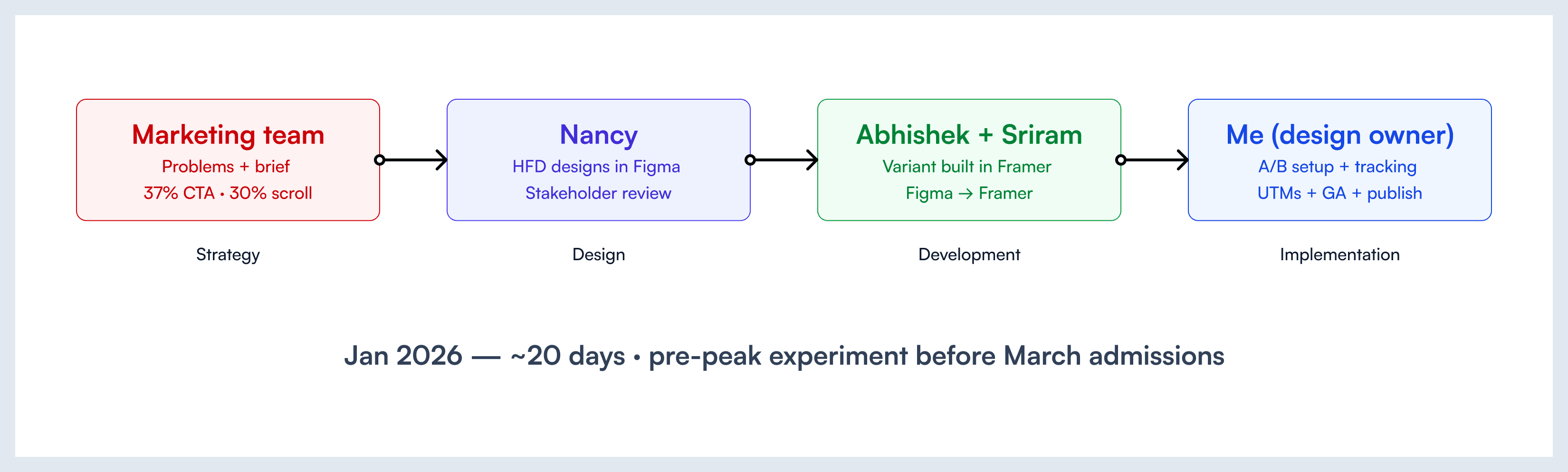
Marketing team defined the problem and the brief — the scroll depth and click rate data, and the target metrics they needed us to hit.

Marketing team defined the problem and the brief — the scroll depth and click rate data, and the target metrics they needed us to hit.

Marketing team defined the problem and the brief — the scroll depth and click rate data, and the target metrics they needed us to hit.

Nancy, our designer, took the brief and created high-fidelity designs in Figma. The brief had specific directives: reduce the overall page length, create a cleaner visual hierarchy with a new design language, reposition CTAs for higher visibility earlier in the scroll journey, and add a mid-page Apply Now that users would encounter before the usual drop-off point. Once the HFDs were complete, they went through review rounds with the broader design team and stakeholder approvals before any development started.

Nancy, our designer, took the brief and created high-fidelity designs in Figma. The brief had specific directives: reduce the overall page length, create a cleaner visual hierarchy with a new design language, reposition CTAs for higher visibility earlier in the scroll journey, and add a mid-page Apply Now that users would encounter before the usual drop-off point. Once the HFDs were complete, they went through review rounds with the broader design team and stakeholder approvals before any development started.

Nancy, our designer, took the brief and created high-fidelity designs in Figma. The brief had specific directives: reduce the overall page length, create a cleaner visual hierarchy with a new design language, reposition CTAs for higher visibility earlier in the scroll journey, and add a mid-page Apply Now that users would encounter before the usual drop-off point. Once the HFDs were complete, they went through review rounds with the broader design team and stakeholder approvals before any development started.

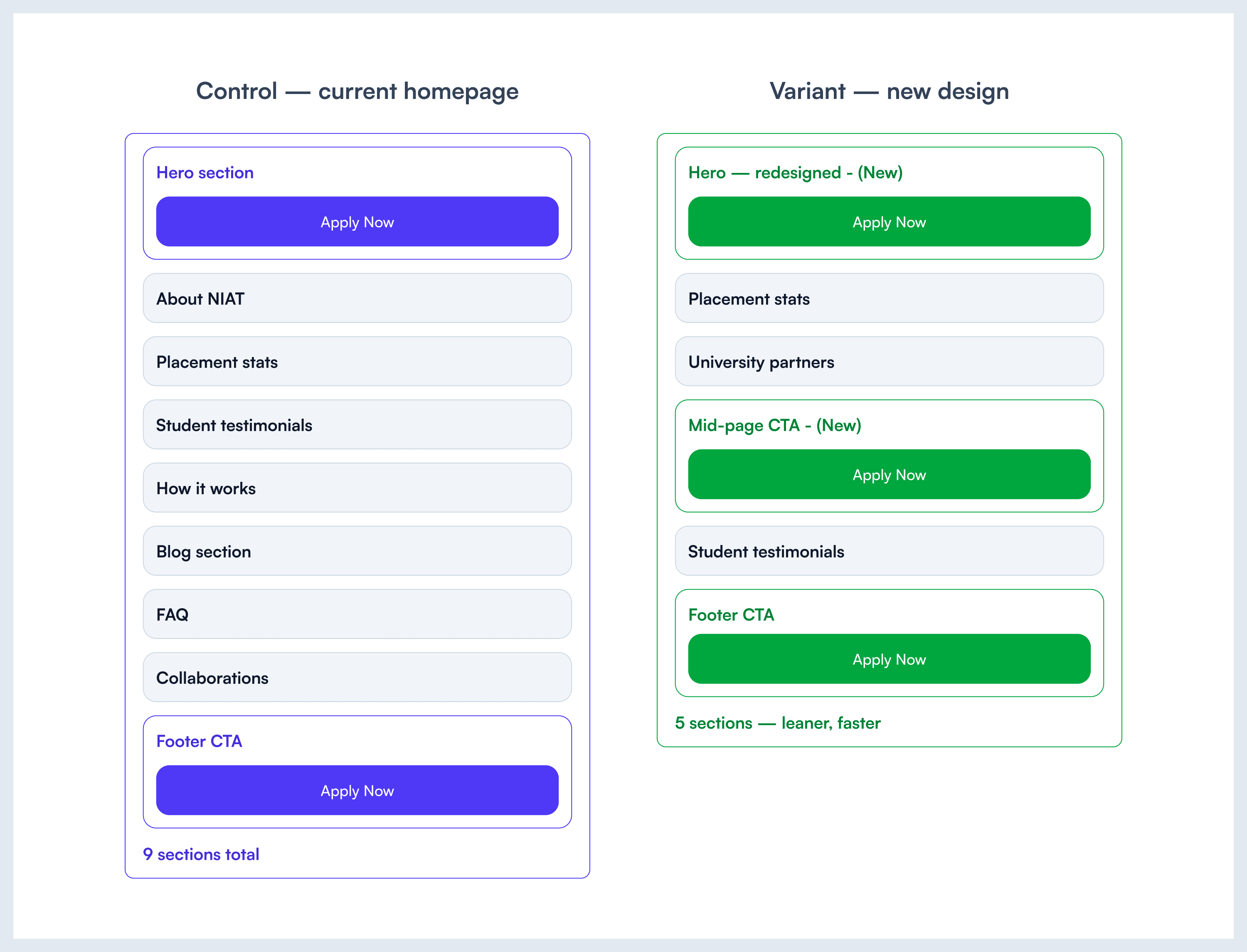
Abhishek and Sriram took Nancy's approved Figma frames and implemented them in Framer, building the variant page from scratch. The new design brought the page from 9 sections down to 5 — removing About NIAT, How It Works, Blog, FAQ, and Collaborations — and added a mid-page CTA between the placement stats and testimonials sections.

Abhishek and Sriram took Nancy's approved Figma frames and implemented them in Framer, building the variant page from scratch. The new design brought the page from 9 sections down to 5 — removing About NIAT, How It Works, Blog, FAQ, and Collaborations — and added a mid-page CTA between the placement stats and testimonials sections.

Abhishek and Sriram took Nancy's approved Figma frames and implemented them in Framer, building the variant page from scratch. The new design brought the page from 9 sections down to 5 — removing About NIAT, How It Works, Blog, FAQ, and Collaborations — and added a mid-page CTA between the placement stats and testimonials sections.

My role was to take ownership of the entire A/B testing implementation — researching how to set it up properly in Framer, building the tracking architecture, connecting it to Google Analytics, and making sure the whole experiment would yield clean, trustworthy data. I also managed the process end-to-end: keeping the timeline moving, coordinating between the team and stakeholders, and making the final call on when to publish.

My role was to take ownership of the entire A/B testing implementation — researching how to set it up properly in Framer, building the tracking architecture, connecting it to Google Analytics, and making sure the whole experiment would yield clean, trustworthy data. I also managed the process end-to-end: keeping the timeline moving, coordinating between the team and stakeholders, and making the final call on when to publish.

My role was to take ownership of the entire A/B testing implementation — researching how to set it up properly in Framer, building the tracking architecture, connecting it to Google Analytics, and making sure the whole experiment would yield clean, trustworthy data. I also managed the process end-to-end: keeping the timeline moving, coordinating between the team and stakeholders, and making the final call on when to publish.

The technical challenge: a two-domain problem
The technical challenge: a two-domain problem

The technical challenge: a two-domain problem

Here is where this experiment required more than just clicking a toggle in Framer.

Here is where this experiment required more than just clicking a toggle in Framer.

Here is where this experiment required more than just clicking a toggle in Framer.

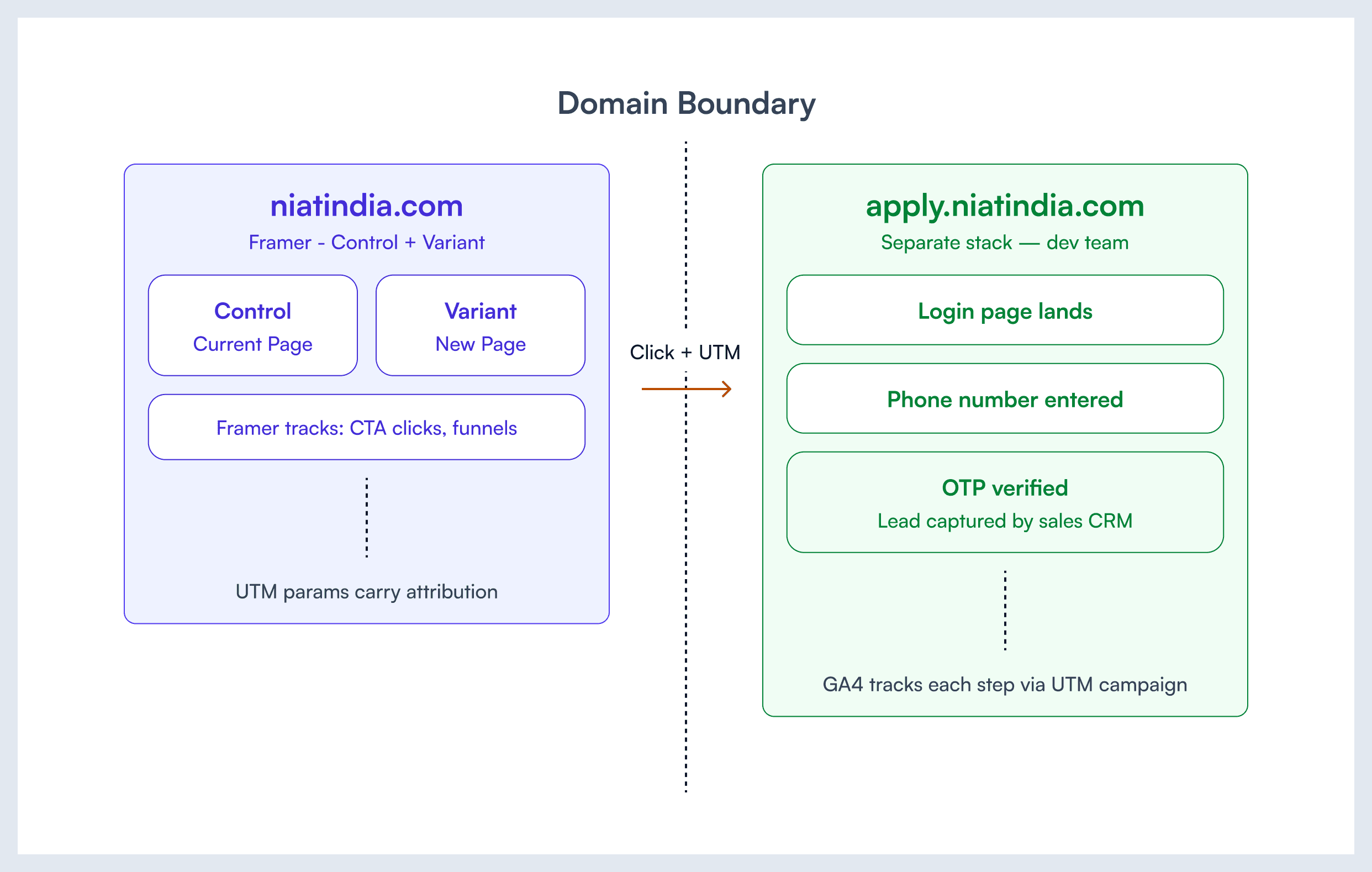
Our setup had a domain boundary problem. The NIAT website at niatindia.com was built and hosted entirely in Framer. But the application portal at apply.niatindia.com was a completely separate application — built by our engineering team in a different stack, hosted independently, with no connection to Framer.

Our setup had a domain boundary problem. The NIAT website at niatindia.com was built and hosted entirely in Framer. But the application portal at apply.niatindia.com was a completely separate application — built by our engineering team in a different stack, hosted independently, with no connection to Framer.

Our setup had a domain boundary problem. The NIAT website at niatindia.com was built and hosted entirely in Framer. But the application portal at apply.niatindia.com was a completely separate application — built by our engineering team in a different stack, hosted independently, with no connection to Framer.

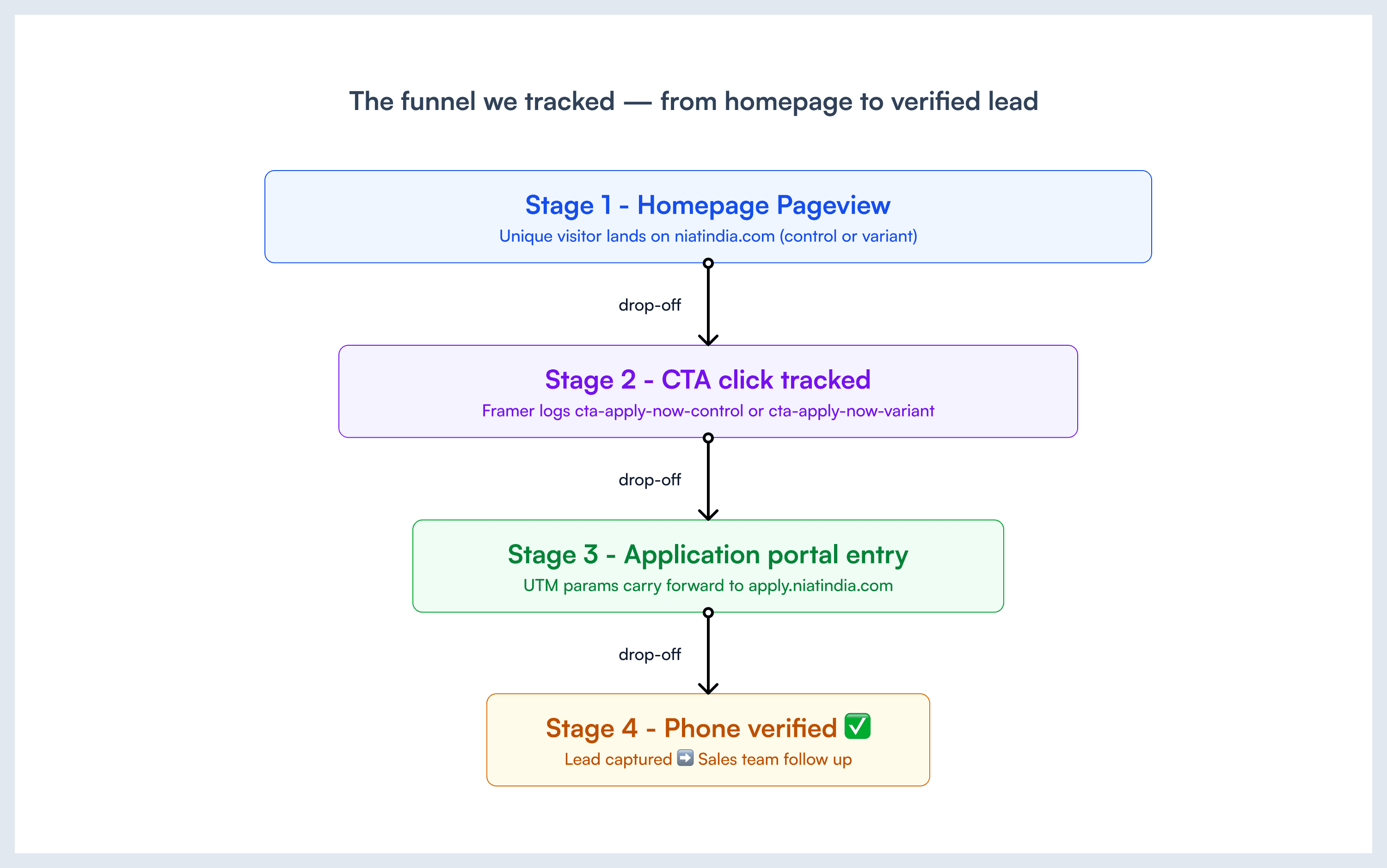
Framer can track clicks within its own environment. The moment a user clicks Apply Now and crosses into the application portal, Framer's visibility ends. But our real conversion goal was not the click — it was the OTP verification step on the portal. That is the moment a user becomes a lead in our CRM and the sales team can follow up.

Framer can track clicks within its own environment. The moment a user clicks Apply Now and crosses into the application portal, Framer's visibility ends. But our real conversion goal was not the click — it was the OTP verification step on the portal. That is the moment a user becomes a lead in our CRM and the sales team can follow up.

Framer can track clicks within its own environment. The moment a user clicks Apply Now and crosses into the application portal, Framer's visibility ends. But our real conversion goal was not the click — it was the OTP verification step on the portal. That is the moment a user becomes a lead in our CRM and the sales team can follow up.

If we could not track that step, we would only know who clicked, not who actually registered. And a click without a registration is not a conversion.

If we could not track that step, we would only know who clicked, not who actually registered. And a click without a registration is not a conversion.

If we could not track that step, we would only know who clicked, not who actually registered. And a click without a registration is not a conversion.

The solution was UTM parameters — appended to every Apply Now button link on both versions. When a user clicks and lands on apply.niatindia.com, those parameters travel with them in the URL and remain there for their entire session on the portal. Google Analytics picks them up and tags every subsequent event — page views, form interactions, OTP submission — with the campaign value.

The solution was UTM parameters — appended to every Apply Now button link on both versions. When a user clicks and lands on apply.niatindia.com, those parameters travel with them in the URL and remain there for their entire session on the portal. Google Analytics picks them up and tags every subsequent event — page views, form interactions, OTP submission — with the campaign value.

The solution was UTM parameters — appended to every Apply Now button link on both versions. When a user clicks and lands on apply.niatindia.com, those parameters travel with them in the URL and remain there for their entire session on the portal. Google Analytics picks them up and tags every subsequent event — page views, form interactions, OTP submission — with the campaign value.

Step by step: how we set it up
Step by step: how we set it up

Step by step: how we set it up

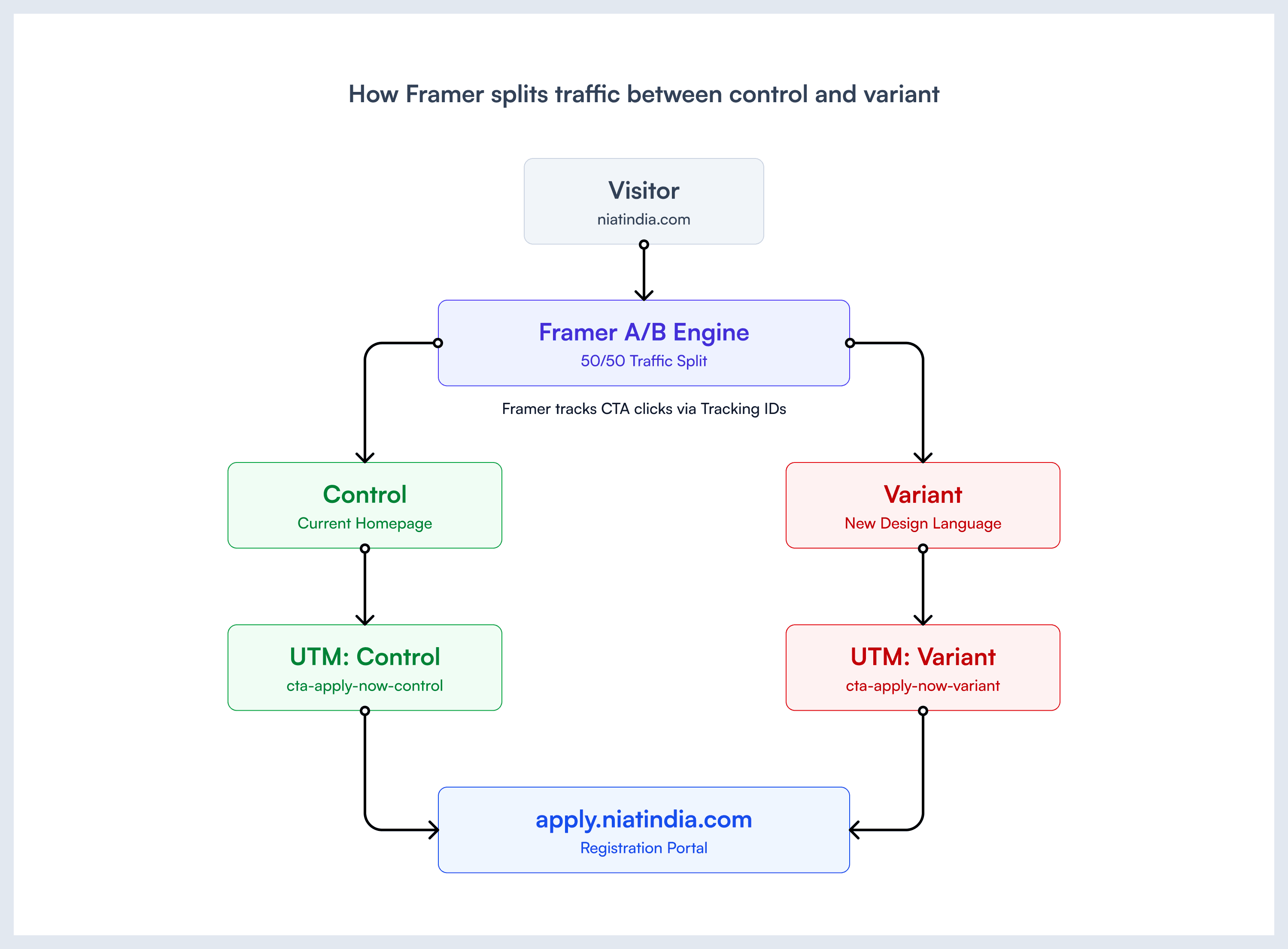
The implementation broke down into six clear steps: creating the A/B test in Framer from the page menu, labelling control and variant, assigning Tracking IDs to every CTA button on both versions, appending UTM parameters to all destination links, setting up Funnels in Framer Analytics, and verifying everything on staging before going live.

The implementation broke down into six clear steps: creating the A/B test in Framer from the page menu, labelling control and variant, assigning Tracking IDs to every CTA button on both versions, appending UTM parameters to all destination links, setting up Funnels in Framer Analytics, and verifying everything on staging before going live.

The implementation broke down into six clear steps: creating the A/B test in Framer from the page menu, labelling control and variant, assigning Tracking IDs to every CTA button on both versions, appending UTM parameters to all destination links, setting up Funnels in Framer Analytics, and verifying everything on staging before going live.

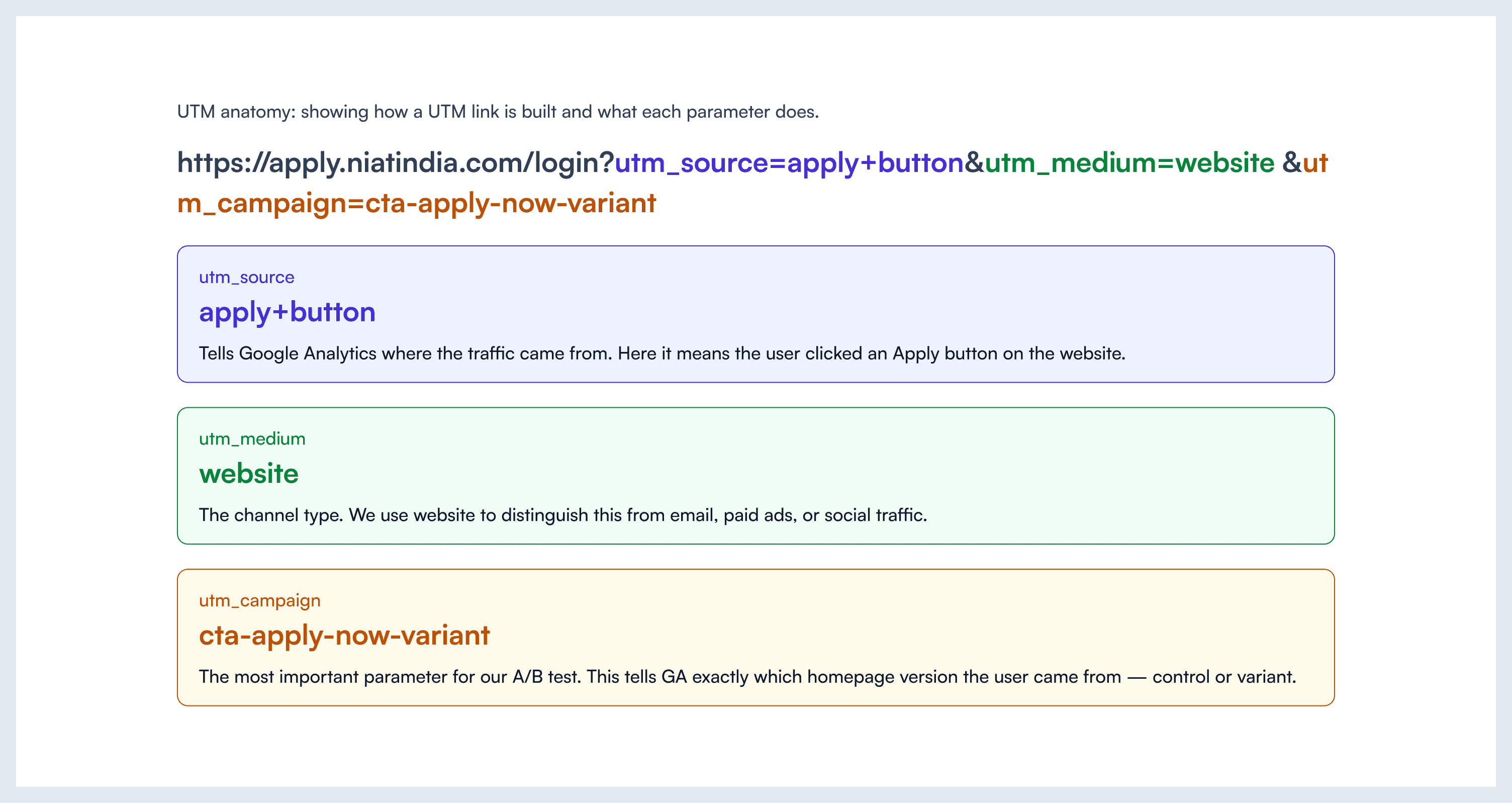
For the UTM parameters specifically, the structure we used was:

For the UTM parameters specifically, the structure we used was:

For the UTM parameters specifically, the structure we used was:

Every Apply Now button on the control page linked to:

Every Apply Now button on the control page linked to:

Every Apply Now button on the control page linked to:

https://apply.niatindia.com/login?utm_source=apply+button&utm_medium=website&utm_campaign=cta-apply-now-control

https://apply.niatindia.com/login?utm_source=apply+button&utm_medium=website&utm_campaign=cta-apply-now-control

https://apply.niatindia.com/login?utm_source=apply+button&utm_medium=website&utm_campaign=cta-apply-now-control

And on the variant:
And on the variant:

And on the variant:

https://apply.niatindia.com/login?utm_source=apply+button&utm_medium=website&utm_campaign=cta-apply-now-variant

https://apply.niatindia.com/login?utm_source=apply+button&utm_medium=website&utm_campaign=cta-apply-now-variant

https://apply.niatindia.com/login?utm_source=apply+button&utm_medium=website&utm_campaign=cta-apply-now-variant

The utm_campaign value was the critical one — it is what allowed GA4 to separate the two user cohorts all the way through the application portal funnel.

The utm_campaign value was the critical one — it is what allowed GA4 to separate the two user cohorts all the way through the application portal funnel.

The utm_campaign value was the critical one — it is what allowed GA4 to separate the two user cohorts all the way through the application portal funnel.

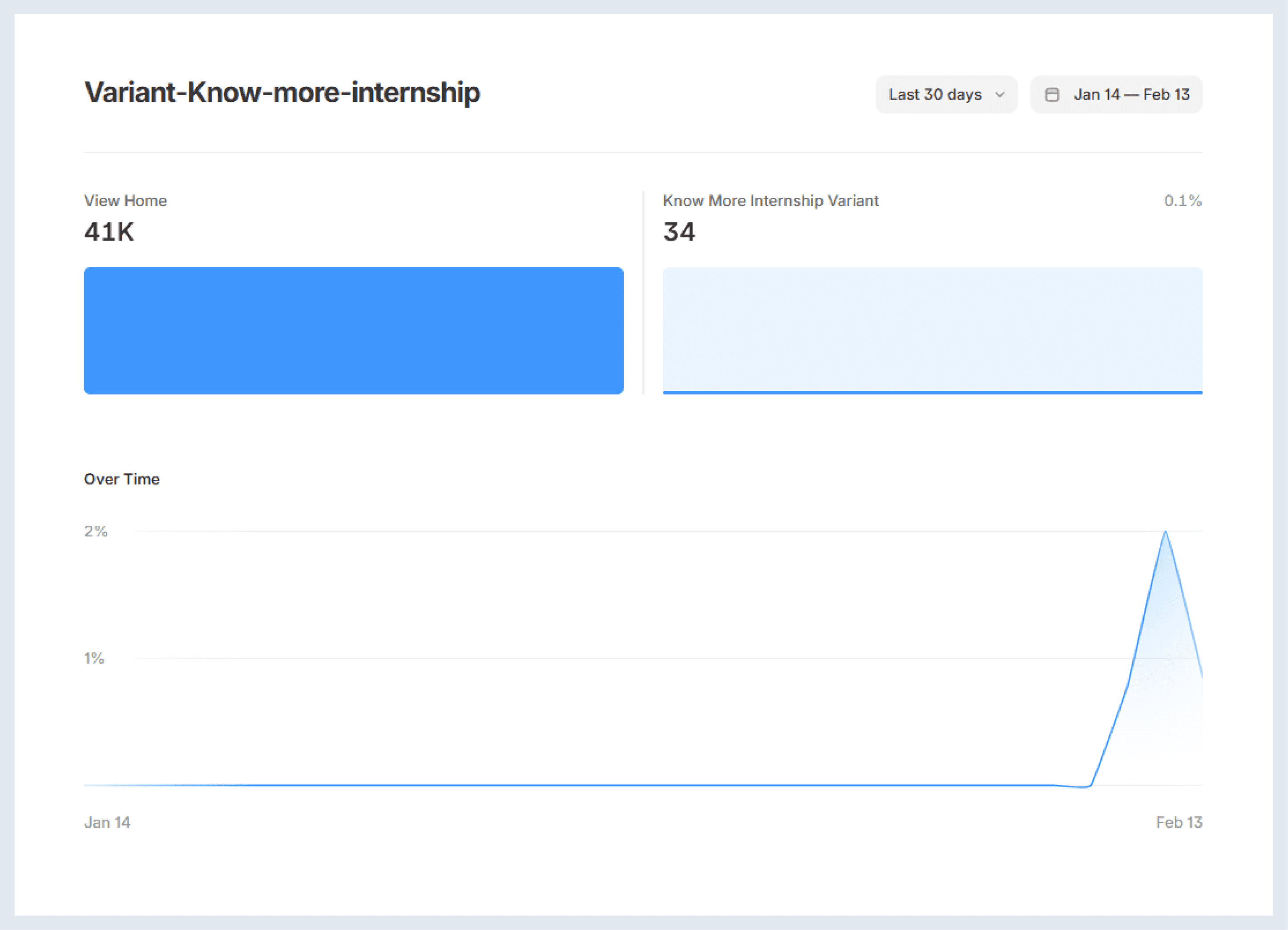
Beyond the primary Apply Now tracking, we also set up a secondary tracking event — "Know More Internship" — to understand engagement with other elements of the page. This gave us additional signal beyond just the conversion CTA, and it became a useful reference for future experiments.

Beyond the primary Apply Now tracking, we also set up a secondary tracking event — "Know More Internship" — to understand engagement with other elements of the page. This gave us additional signal beyond just the conversion CTA, and it became a useful reference for future experiments.

Beyond the primary Apply Now tracking, we also set up a secondary tracking event — "Know More Internship" — to understand engagement with other elements of the page. This gave us additional signal beyond just the conversion CTA, and it became a useful reference for future experiments.

Going live and reading the data
Going live and reading the data

Going live and reading the data

We published the A/B test to Framer's staging environment first, ran through every user journey manually on both versions, confirmed UTM parameters were carrying through to the portal URL, and verified GA4 was receiving events with the correct campaign attribution. Once everything checked out, we pushed to production.

We published the A/B test to Framer's staging environment first, ran through every user journey manually on both versions, confirmed UTM parameters were carrying through to the portal URL, and verified GA4 was receiving events with the correct campaign attribution. Once everything checked out, we pushed to production.

We published the A/B test to Framer's staging environment first, ran through every user journey manually on both versions, confirmed UTM parameters were carrying through to the portal URL, and verified GA4 was receiving events with the correct campaign attribution. Once everything checked out, we pushed to production.

Framer begins splitting traffic immediately — 50/50 per session — and click data starts appearing within minutes. GA4 data has a ~24-hour processing delay, so we waited a full day before drawing any conclusions.

Framer begins splitting traffic immediately — 50/50 per session — and click data starts appearing within minutes. GA4 data has a ~24-hour processing delay, so we waited a full day before drawing any conclusions.

Framer begins splitting traffic immediately — 50/50 per session — and click data starts appearing within minutes. GA4 data has a ~24-hour processing delay, so we waited a full day before drawing any conclusions.

Over the roughly 20-day test window in January 2026, we accumulated enough data for a clear result.

Over the roughly 20-day test window in January 2026, we accumulated enough data for a clear result.

Over the roughly 20-day test window in January 2026, we accumulated enough data for a clear result.

The numbers were decisive.
The numbers were decisive.

The numbers were decisive.

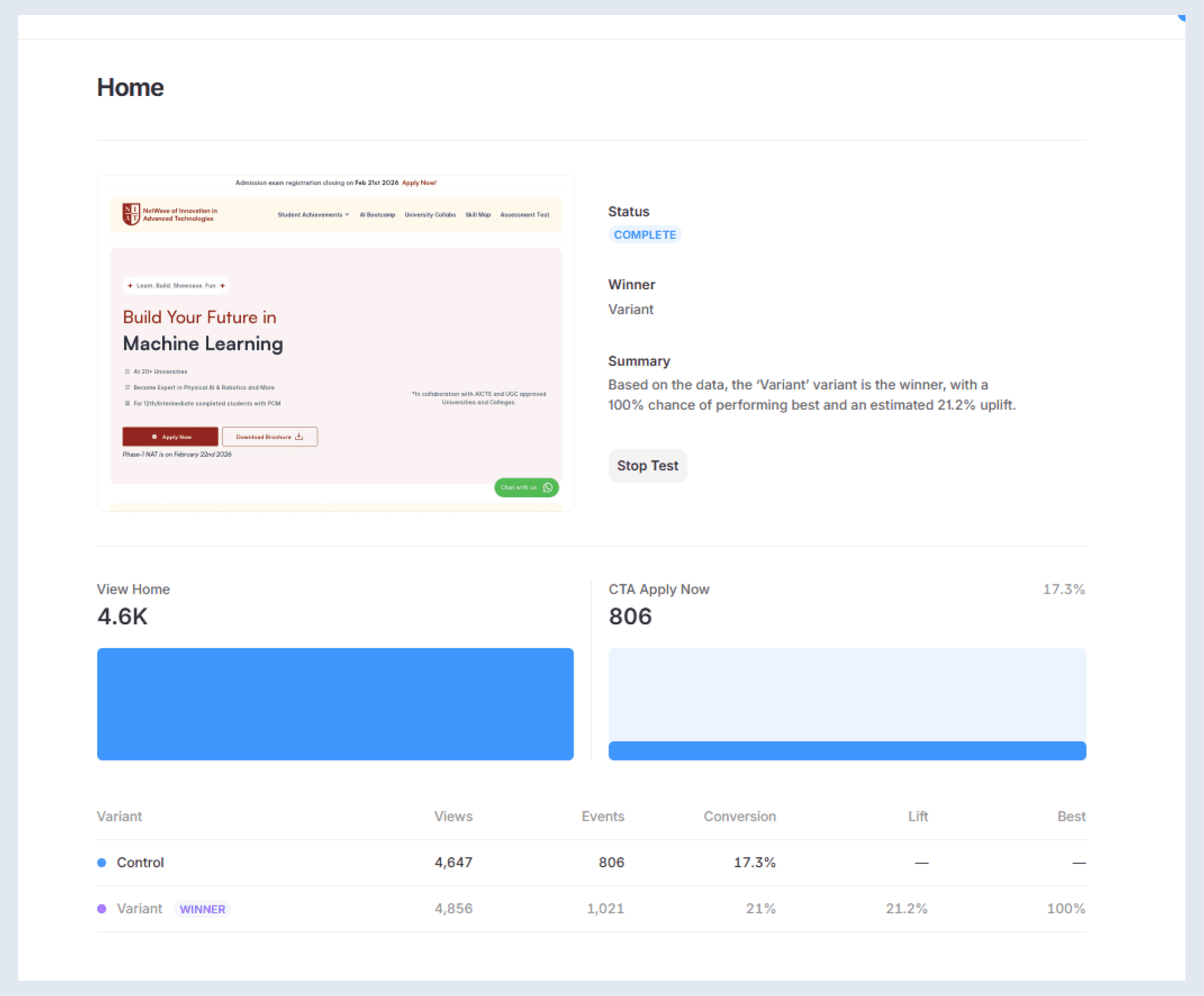
The variant received 4,856 views and generated 1,021 CTA clicks — a 21% conversion rate. The control received 4,647 views and generated 806 clicks — a 17.3% conversion rate. That is a 21.2% uplift for the variant, with 100% probability of winning. Framer marked the test Complete and named the variant the winner.

The variant received 4,856 views and generated 1,021 CTA clicks — a 21% conversion rate. The control received 4,647 views and generated 806 clicks — a 17.3% conversion rate. That is a 21.2% uplift for the variant, with 100% probability of winning. Framer marked the test Complete and named the variant the winner.

The variant received 4,856 views and generated 1,021 CTA clicks — a 21% conversion rate. The control received 4,647 views and generated 806 clicks — a 17.3% conversion rate. That is a 21.2% uplift for the variant, with 100% probability of winning. Framer marked the test Complete and named the variant the winner.

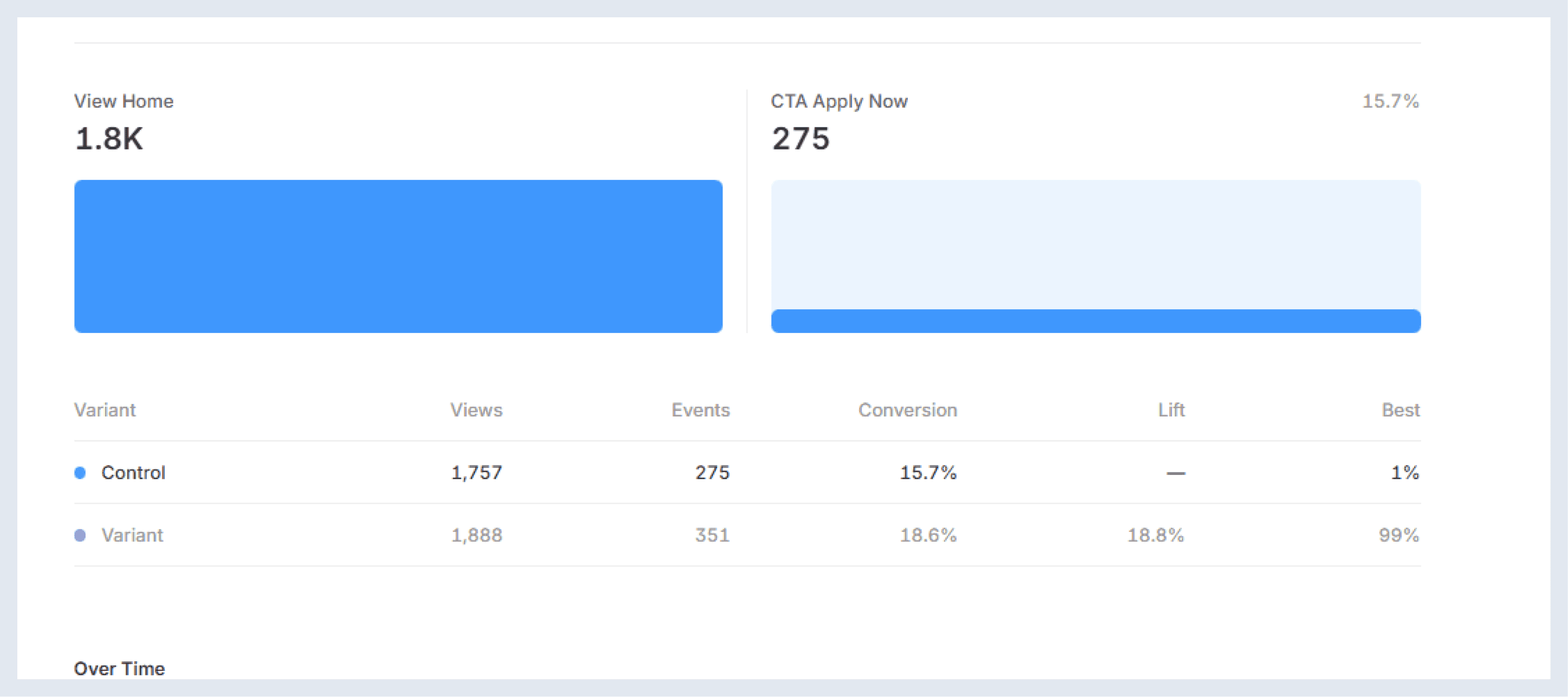
We also looked at an earlier snapshot during the run — at around 1,757 vs 1,888 views — and the variant was already showing 18.6% vs 15.7% with 99% probability to win. The signal was consistent from early in the experiment.

We also looked at an earlier snapshot during the run — at around 1,757 vs 1,888 views — and the variant was already showing 18.6% vs 15.7% with 99% probability to win. The signal was consistent from early in the experiment.

We also looked at an earlier snapshot during the run — at around 1,757 vs 1,888 views — and the variant was already showing 18.6% vs 15.7% with 99% probability to win. The signal was consistent from early in the experiment.

The secondary tracking for "Know More Internship" told a smaller but interesting story — 34 clicks on the variant vs 33 on the control, both at 0.1% across 41K views. Not a significant difference, but it confirmed users on both versions were engaging with that section at similar rates.

The secondary tracking for "Know More Internship" told a smaller but interesting story — 34 clicks on the variant vs 33 on the control, both at 0.1% across 41K views. Not a significant difference, but it confirmed users on both versions were engaging with that section at similar rates.

The secondary tracking for "Know More Internship" told a smaller but interesting story — 34 clicks on the variant vs 33 on the control, both at 0.1% across 41K views. Not a significant difference, but it confirmed users on both versions were engaging with that section at similar rates.

What we did with the results

What we did with the results

What we did with the results

Once the variant reached 100% probability of winning, we made the call. The variant was promoted to the primary homepage — it became the new default for niatindia.com, live and ready before the March peak season. The control page was not deleted. It lives in Framer as an archived page, preserving the baseline data, the design decisions, and the context for anyone who works on the site in the future.

Once the variant reached 100% probability of winning, we made the call. The variant was promoted to the primary homepage — it became the new default for niatindia.com, live and ready before the March peak season. The control page was not deleted. It lives in Framer as an archived page, preserving the baseline data, the design decisions, and the context for anyone who works on the site in the future.

Once the variant reached 100% probability of winning, we made the call. The variant was promoted to the primary homepage — it became the new default for niatindia.com, live and ready before the March peak season. The control page was not deleted. It lives in Framer as an archived page, preserving the baseline data, the design decisions, and the context for anyone who works on the site in the future.

This is the standard post-test workflow we now follow for every experiment: declare the winner once statistical confidence is reached, publish the winning version, archive the losing version with its data, document the learnings, and begin scoping the next experiment.

This is the standard post-test workflow we now follow for every experiment: declare the winner once statistical confidence is reached, publish the winning version, archive the losing version with its data, document the learnings, and begin scoping the next experiment.

This is the standard post-test workflow we now follow for every experiment: declare the winner once statistical confidence is reached, publish the winning version, archive the losing version with its data, document the learnings, and begin scoping the next experiment.

The results in summary

The results in summary

The results in summary

Going into peak season 2026, the NIAT homepage was now running on a design that had been proven — not assumed — to perform better. The variant produced a 21.2% uplift in CTA clicks, with the confidence to back it up. The scroll-depth and attention-zone problems the marketing team raised were addressed through a leaner page with more strategically placed CTAs. And the GA4 funnel data surfaced a new optimisation opportunity inside the application portal that the team could act on independently.

Going into peak season 2026, the NIAT homepage was now running on a design that had been proven — not assumed — to perform better. The variant produced a 21.2% uplift in CTA clicks, with the confidence to back it up. The scroll-depth and attention-zone problems the marketing team raised were addressed through a leaner page with more strategically placed CTAs. And the GA4 funnel data surfaced a new optimisation opportunity inside the application portal that the team could act on independently.

Going into peak season 2026, the NIAT homepage was now running on a design that had been proven — not assumed — to perform better. The variant produced a 21.2% uplift in CTA clicks, with the confidence to back it up. The scroll-depth and attention-zone problems the marketing team raised were addressed through a leaner page with more strategically placed CTAs. And the GA4 funnel data surfaced a new optimisation opportunity inside the application portal that the team could act on independently.

Twenty days of testing in January set up the entire peak season to perform better.

Twenty days of testing in January set up the entire peak season to perform better.

Twenty days of testing in January set up the entire peak season to perform better.

Learnings and What I'd Do Differently

Learnings and What I'd Do Differently

Learnings and What I'd Do Differently

Running this experiment gave me a much sharper appreciation for a few things that aren't obvious until you actually do them:

Running this experiment gave me a much sharper appreciation for a few things that aren't obvious until you actually do them:

Running this experiment gave me a much sharper appreciation for a few things that aren't obvious until you actually do them:

UTM parameters are your most important infrastructure.

UTM parameters are your most important infrastructure.

UTM parameters are your most important infrastructure.

When your website and your conversion goal live on different domains, UTMs are the only reliable thread connecting them. Getting the naming convention right from day one — consistent, descriptive, parseable — saves you enormous headaches when you're staring at GA data at 11pm trying to understand a dip.

When your website and your conversion goal live on different domains, UTMs are the only reliable thread connecting them. Getting the naming convention right from day one — consistent, descriptive, parseable — saves you enormous headaches when you're staring at GA data at 11pm trying to understand a dip.

When your website and your conversion goal live on different domains, UTMs are the only reliable thread connecting them. Getting the naming convention right from day one — consistent, descriptive, parseable — saves you enormous headaches when you're staring at GA data at 11pm trying to understand a dip.

Define your primary conversion event before you start.

Define your primary conversion event before you start.

Define your primary conversion event before you start.

We were clear from the beginning: the phone verification step on the application portal was the signal that mattered. Not the click, not the portal landing — the verified phone number. If we had defined "success" as CTA clicks, we would have been measuring the wrong thing. North star clarity is everything.

We were clear from the beginning: the phone verification step on the application portal was the signal that mattered. Not the click, not the portal landing — the verified phone number. If we had defined "success" as CTA clicks, we would have been measuring the wrong thing. North star clarity is everything.

We were clear from the beginning: the phone verification step on the application portal was the signal that mattered. Not the click, not the portal landing — the verified phone number. If we had defined "success" as CTA clicks, we would have been measuring the wrong thing. North star clarity is everything.

Framer's native A/B testing is more capable than most people realize.

Framer's native A/B testing is more capable than most people realize.

Framer's native A/B testing is more capable than most people realize.

The combination of Tracking IDs, Funnels, and the analytics panel gave us a solid first layer of data without any third-party tooling. Adding UTM parameters to carry attribution forward was the bridge that made it truly production-grade.

The combination of Tracking IDs, Funnels, and the analytics panel gave us a solid first layer of data without any third-party tooling. Adding UTM parameters to carry attribution forward was the bridge that made it truly production-grade.

The combination of Tracking IDs, Funnels, and the analytics panel gave us a solid first layer of data without any third-party tooling. Adding UTM parameters to carry attribution forward was the bridge that made it truly production-grade.

Seasonal timing matters

Seasonal timing matters

Seasonal timing matters

Running the test during peak traffic (March–August) meant we reached statistical significance faster than we would have in an off-peak period. If you're running tests on a site with seasonal patterns, plan your experiments to coincide with your highest-traffic windows.

Running the test during peak traffic (March–August) meant we reached statistical significance faster than we would have in an off-peak period. If you're running tests on a site with seasonal patterns, plan your experiments to coincide with your highest-traffic windows.

Running the test during peak traffic (March–August) meant we reached statistical significance faster than we would have in an off-peak period. If you're running tests on a site with seasonal patterns, plan your experiments to coincide with your highest-traffic windows.

The variant doesn't always need to be radically different.

The variant doesn't always need to be radically different.

The variant doesn't always need to be radically different.

The changes we tested — reduced page length, repositioned CTAs, a new design language — might seem incremental. But on a page receiving 1.2M unique visitors annually, even a few percentage points of improvement in conversion rate is tens of thousands of additional leads. Incremental improvements at scale are transformative.

The changes we tested — reduced page length, repositioned CTAs, a new design language — might seem incremental. But on a page receiving 1.2M unique visitors annually, even a few percentage points of improvement in conversion rate is tens of thousands of additional leads. Incremental improvements at scale are transformative.

The changes we tested — reduced page length, repositioned CTAs, a new design language — might seem incremental. But on a page receiving 1.2M unique visitors annually, even a few percentage points of improvement in conversion rate is tens of thousands of additional leads. Incremental improvements at scale are transformative.

Tools used

Tools used

Tools used

Framer

Framer

Framer

website, A/B test setup, Tracking IDs, Funnels, Analytics

website, A/B test setup, Tracking IDs, Funnels, Analytics

website, A/B test setup, Tracking IDs, Funnels, Analytics

Figma

Figma

Figma

high-fidelity design of the variant

high-fidelity design of the variant

high-fidelity design of the variant

Google Analytics 4

Google Analytics 4

Google Analytics 4

downstream conversion tracking via UTM parameters

downstream conversion tracking via UTM parameters

downstream conversion tracking via UTM parameters

apply.niatindia.com

apply.niatindia.com

apply.niatindia.com

application portal (external domain, separate stack)

application portal (external domain, separate stack)

application portal (external domain, separate stack)

Want to work together?

Feel free to reach out for collaborations, inquiries, or just to say hello.

Want to work together?

Feel free to reach out for collaborations, inquiries, or just to say hello.

Want to work together?

Feel free to reach out for collaborations, inquiries, or just to say hello.

Let's Be Friends

Feel Free to Hit Me Up!

I always enjoyed product discussions and If you’re a startup founder or PM/Growth person and interested to chat! Hit me up on any social media platforms.


Crafted with ❤️ on Framer, All Rights Reserved © 2026 Guruprakash.

Let's Be Friends

Feel Free to Hit Me Up!

I always enjoyed product discussions and If you’re a startup founder or PM/Growth person and interested to chat! Hit me up on any social media platforms.

Crafted with ❤️ on Framer, All Rights Reserved © 2025 Guruprakash.

Let's Be Friends

Feel Free to Hit Me Up!

I always enjoyed product discussions and If you’re a startup founder or PM/Growth person and interested to chat! Hit me up on any social media platforms.

Crafted with ❤️ on Framer

All Rights Reserved © 2025 Guruprakash.