Back to Notes
From Passive Lectures to Living Classrooms — How I Designed the In-Platform Live Quiz for NIAT Students.
From Passive Lectures to Living Classrooms — How I Designed the In-Platform Live Quiz for NIAT Students.
From Passive Lectures to Living Classrooms — How I Designed the In-Platform Live Quiz for NIAT Students.
A walkthrough of how I designed and shipped the Live Quiz feature for NIAT classrooms — research, psychology, design decisions, and impact.
A walkthrough of how I designed and shipped the Live Quiz feature for NIAT classrooms — research, psychology, design decisions, and impact.
A walkthrough of how I designed and shipped the Live Quiz feature for NIAT classrooms — research, psychology, design decisions, and impact.
Introduction
Introduction
Introduction
Most case studies start with a roadmap. This one started with a pattern in the assessment data we couldn't ignore.
Most case studies start with a roadmap. This one started with a pattern in the assessment data we couldn't ignore.
Most case studies start with a roadmap. This one started with a pattern in the assessment data we couldn't ignore.
For weeks, students at NIAT were under-performing in the weekly assessments — not catastrophically, but consistently. Section averages dipped on specific concepts in specific weeks. The same handful of topics flagged red across many sections. So we did the obvious thing. We sat at the back of those classrooms with notebooks. We watched the live sessions. And then we talked to the students who'd struggled the most.
For weeks, students at NIAT were under-performing in the weekly assessments — not catastrophically, but consistently. Section averages dipped on specific concepts in specific weeks. The same handful of topics flagged red across many sections. So we did the obvious thing. We sat at the back of those classrooms with notebooks. We watched the live sessions. And then we talked to the students who'd struggled the most.
For weeks, students at NIAT were under-performing in the weekly assessments — not catastrophically, but consistently. Section averages dipped on specific concepts in specific weeks. The same handful of topics flagged red across many sections. So we did the obvious thing. We sat at the back of those classrooms with notebooks. We watched the live sessions. And then we talked to the students who'd struggled the most.
What they told us reorganised the entire problem.
What they told us reorganised the entire problem.
What they told us reorganised the entire problem.
The students had attended the class. They had taken notes. They had listened. And by the time they sat down for the weekly assessment 5–7 days later, they had simply forgotten what was being asked. The instructor had moved on through three more topics. The doubt that had crossed their mind in the moment of confusion had decayed into vague unease by the time the test arrived.
The students had attended the class. They had taken notes. They had listened. And by the time they sat down for the weekly assessment 5–7 days later, they had simply forgotten what was being asked. The instructor had moved on through three more topics. The doubt that had crossed their mind in the moment of confusion had decayed into vague unease by the time the test arrived.
The students had attended the class. They had taken notes. They had listened. And by the time they sat down for the weekly assessment 5–7 days later, they had simply forgotten what was being asked. The instructor had moved on through three more topics. The doubt that had crossed their mind in the moment of confusion had decayed into vague unease by the time the test arrived.
The diagnostic signal was arriving after the teaching moment had ended.
The diagnostic signal was arriving after the teaching moment had ended.
The diagnostic signal was arriving after the teaching moment had ended.
That was the spark. Not a feature request. Not a roadmap item. A research finding that became a product question.
That was the spark. Not a feature request. Not a roadmap item. A research finding that became a product question.
That was the spark. Not a feature request. Not a roadmap item. A research finding that became a product question.
Can't we run the quiz inside the classroom itself — right after the class ends — so the gap surfaces while everyone is still in the room?
Can't we run the quiz inside the classroom itself — right after the class ends — so the gap surfaces while everyone is still in the room?
Can't we run the quiz inside the classroom itself — right after the class ends — so the gap surfaces while everyone is still in the room?
This is the case study of how that question turned into the In-Platform Live Quiz tool.
This is the case study of how that question turned into the In-Platform Live Quiz tool.
This is the case study of how that question turned into the In-Platform Live Quiz tool.

The Setup You Should Know Before Reading
The Setup You Should Know Before Reading
The Setup You Should Know Before Reading
Every student in a NIAT classroom has a laptop in front of them. The learning platform is laptop-native. The classrooms are laptop-equipped. There are three big LCD displays at the front, dedicated A/V, and structured units. Every interaction described below — joining, answering, reviewing — happens on the same laptop the student was already taking notes on.
Every student in a NIAT classroom has a laptop in front of them. The learning platform is laptop-native. The classrooms are laptop-equipped. There are three big LCD displays at the front, dedicated A/V, and structured units. Every interaction described below — joining, answering, reviewing — happens on the same laptop the student was already taking notes on.
Every student in a NIAT classroom has a laptop in front of them. The learning platform is laptop-native. The classrooms are laptop-equipped. There are three big LCD displays at the front, dedicated A/V, and structured units. Every interaction described below — joining, answering, reviewing — happens on the same laptop the student was already taking notes on.
The class itself is split into two clear phases.
The class itself is split into two clear phases.
The class itself is split into two clear phases.
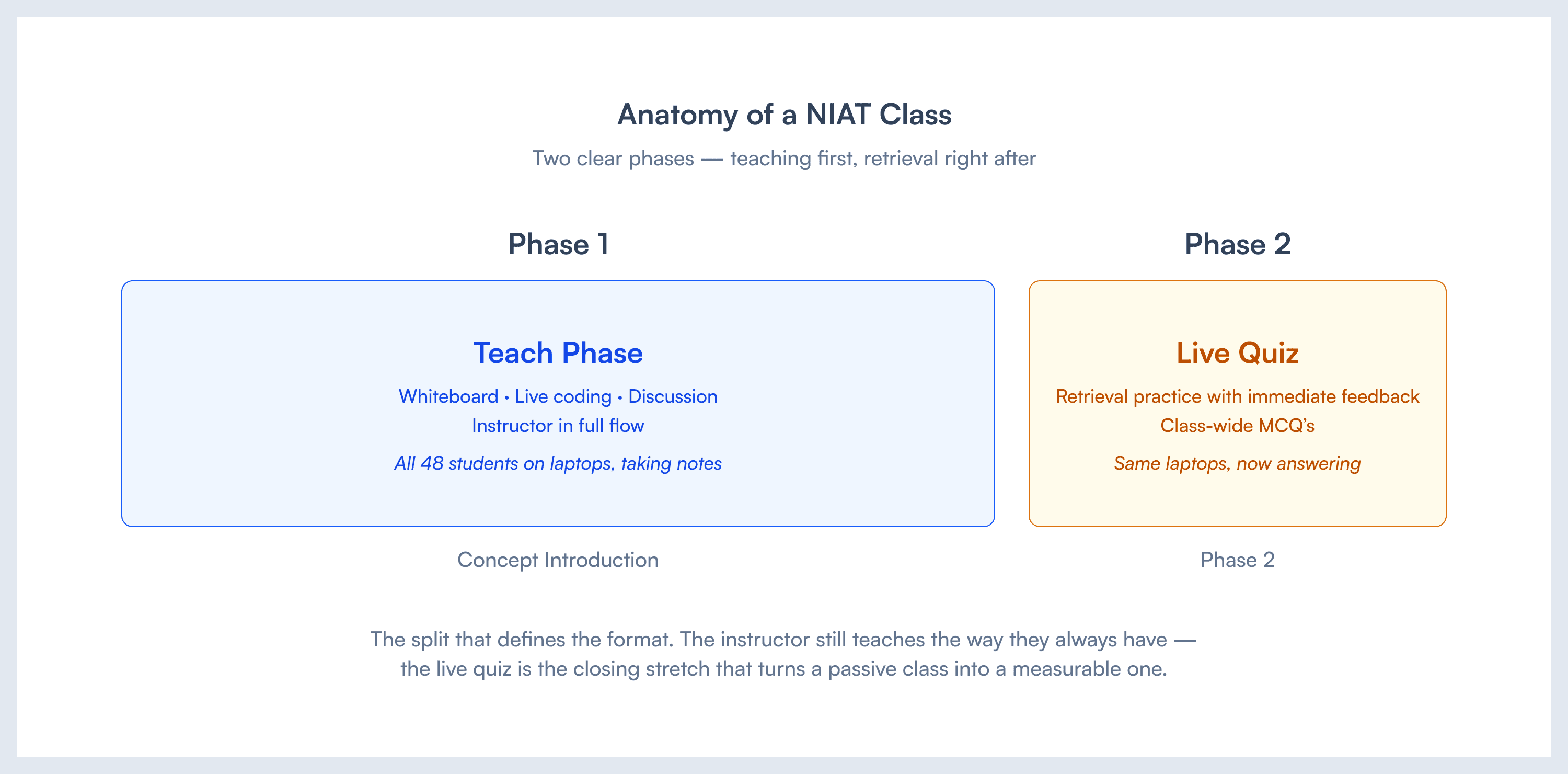
The teach phase is the instructor's domain. Whiteboard, live coding, discussion, the long form of teaching that has been happening in classrooms for centuries. The live quiz phase is what we built. It's the consolidation rep that locks the teaching in.
The teach phase is the instructor's domain. Whiteboard, live coding, discussion, the long form of teaching that has been happening in classrooms for centuries. The live quiz phase is what we built. It's the consolidation rep that locks the teaching in.
The teach phase is the instructor's domain. Whiteboard, live coding, discussion, the long form of teaching that has been happening in classrooms for centuries. The live quiz phase is what we built. It's the consolidation rep that locks the teaching in.
The live quiz is not a replacement for teaching. It's the closing stretch that turns a passive class into a measurable one.
The live quiz is not a replacement for teaching. It's the closing stretch that turns a passive class into a measurable one.
The live quiz is not a replacement for teaching. It's the closing stretch that turns a passive class into a measurable one.
Why the End of the Class, Not the Start
Why the End of the Class, Not the Start
Why the End of the Class, Not the Start
Retrieval practice has its strongest effect when it happens shortly after new information is encoded. Quiz too early and you're testing what students already knew. Quiz too late — next day, next week, exactly when the weekly assessment was running — and the forgetting curve has already done its damage.
Retrieval practice has its strongest effect when it happens shortly after new information is encoded. Quiz too early and you're testing what students already knew. Quiz too late — next day, next week, exactly when the weekly assessment was running — and the forgetting curve has already done its damage.
Retrieval practice has its strongest effect when it happens shortly after new information is encoded. Quiz too early and you're testing what students already knew. Quiz too late — next day, next week, exactly when the weekly assessment was running — and the forgetting curve has already done its damage.
The narrow window between concept taught and concept retrieved is the highest-leverage moment in the day. We wanted to occupy it.
The narrow window between concept taught and concept retrieved is the highest-leverage moment in the day. We wanted to occupy it.
The narrow window between concept taught and concept retrieved is the highest-leverage moment in the day. We wanted to occupy it.
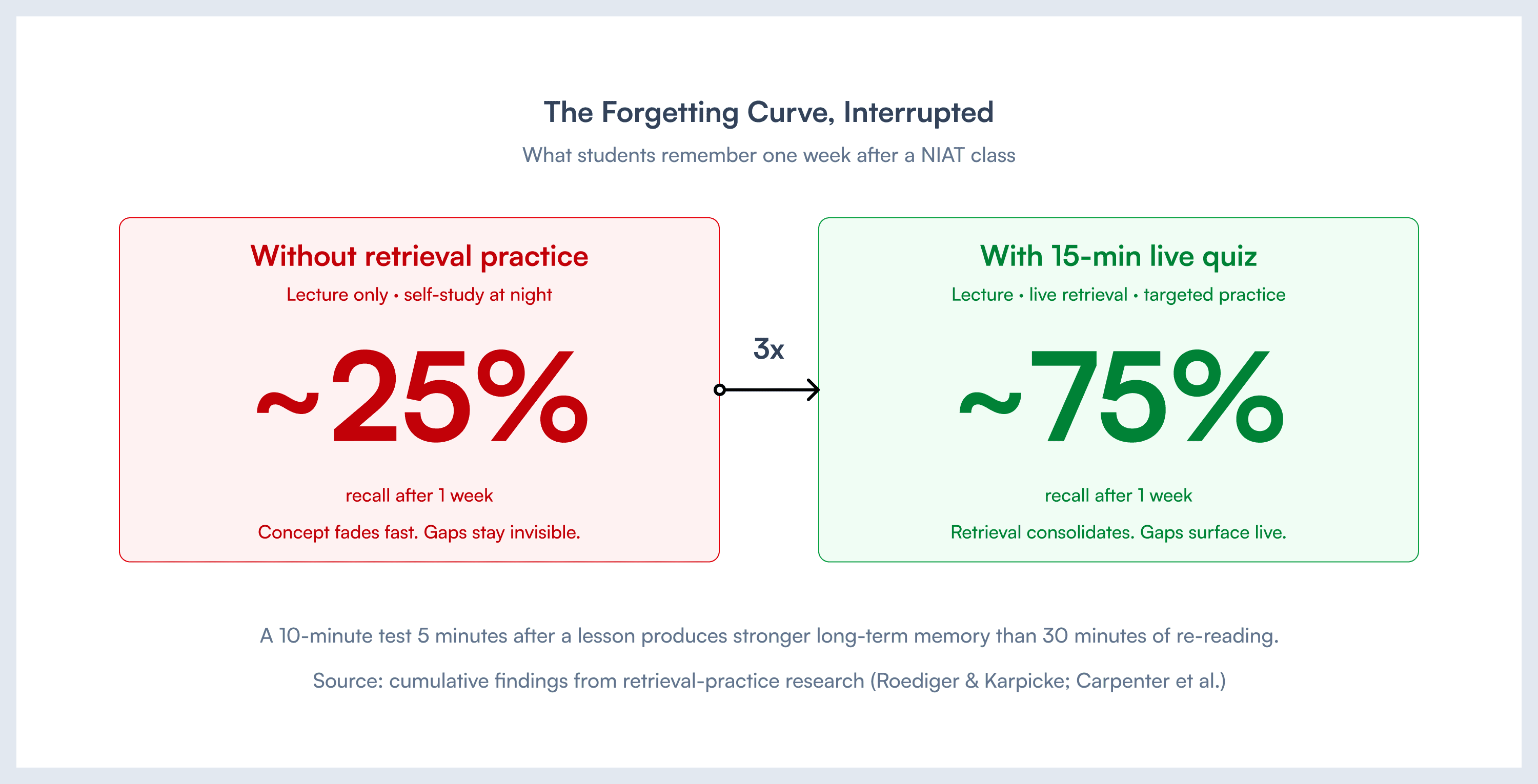
A short test soon after a lesson produces stronger long-term memory than a much longer re-reading session. The brain consolidates what it had to produce, not what it merely recognised. The retention gap at the one-week mark is dramatic. And one week is exactly when the weekly assessment runs.
A short test soon after a lesson produces stronger long-term memory than a much longer re-reading session. The brain consolidates what it had to produce, not what it merely recognised. The retention gap at the one-week mark is dramatic. And one week is exactly when the weekly assessment runs.
A short test soon after a lesson produces stronger long-term memory than a much longer re-reading session. The brain consolidates what it had to produce, not what it merely recognised. The retention gap at the one-week mark is dramatic. And one week is exactly when the weekly assessment runs.
The product implication followed naturally. If we could insert one rep of retrieval practice at the end of every class, the assessment that ran a week later would catch a different cohort — a cohort that had retrieved each concept at least once at the moment of strongest consolidation.
The product implication followed naturally. If we could insert one rep of retrieval practice at the end of every class, the assessment that ran a week later would catch a different cohort — a cohort that had retrieved each concept at least once at the moment of strongest consolidation.
The product implication followed naturally. If we could insert one rep of retrieval practice at the end of every class, the assessment that ran a week later would catch a different cohort — a cohort that had retrieved each concept at least once at the moment of strongest consolidation.
What the Research Surfaced
What the Research Surfaced
What the Research Surfaced
Three short investigations ran in parallel before any design work began.
Three short investigations ran in parallel before any design work began.
Three short investigations ran in parallel before any design work began.
With students (34 interviews across three campuses):
With students (34 interviews across three campuses):
With students (34 interviews across three campuses):
"I zoned out somewhere in the middle of the class. I didn't ask my doubt because I felt I was the only one who didn't get it. By the time I sat for the weekly assessment, I'd forgotten the entire concept — that's why I didn't do well on it. The doubt I had during the class. By the evening, I couldn't even remember what exactly had confused me."
"I zoned out somewhere in the middle of the class. I didn't ask my doubt because I felt I was the only one who didn't get it. By the time I sat for the weekly assessment, I'd forgotten the entire concept — that's why I didn't do well on it. The doubt I had during the class. By the evening, I couldn't even remember what exactly had confused me."
"I zoned out somewhere in the middle of the class. I didn't ask my doubt because I felt I was the only one who didn't get it. By the time I sat for the weekly assessment, I'd forgotten the entire concept — that's why I didn't do well on it. The doubt I had during the class. By the evening, I couldn't even remember what exactly had confused me."
With instructors (11 interviews) — the mirror image:
With instructors (11 interviews) — the mirror image:
With instructors (11 interviews) — the mirror image:
"I ask, 'Any doubts?' Three students say no, I move on. Later, I found out that 30 of them didn't get it. Calibration is gut-feel. Should I repeat? Slow down? I'm guessing. The same lesson lands differently in different sections, and I have no way to see this."
"I ask, 'Any doubts?' Three students say no, I move on. Later, I found out that 30 of them didn't get it. Calibration is gut-feel. Should I repeat? Slow down? I'm guessing. The same lesson lands differently in different sections, and I have no way to see this."
"I ask, 'Any doubts?' Three students say no, I move on. Later, I found out that 30 of them didn't get it. Calibration is gut-feel. Should I repeat? Slow down? I'm guessing. The same lesson lands differently in different sections, and I have no way to see this."
These two sets of pains are not separate problems — they're the same broken signal seen from opposite sides of the room.
These two sets of pains are not separate problems — they're the same broken signal seen from opposite sides of the room.
These two sets of pains are not separate problems — they're the same broken signal seen from opposite sides of the room.
A scan of the live-quiz market:
A scan of the live-quiz market:
A scan of the live-quiz market:
(Kahoot, Quizizz, Mentimeter, Slido, Pear Deck, Nearpod): every existing tool solved engagement or curriculum or analytics — none solved all three inside a single learning loop. Most are external tools that force instructors out of the LMS, build a separate quiz, and lose the data the moment the session ends. That was the wedge.
(Kahoot, Quizizz, Mentimeter, Slido, Pear Deck, Nearpod): every existing tool solved engagement or curriculum or analytics — none solved all three inside a single learning loop. Most are external tools that force instructors out of the LMS, build a separate quiz, and lose the data the moment the session ends. That was the wedge.
(Kahoot, Quizizz, Mentimeter, Slido, Pear Deck, Nearpod): every existing tool solved engagement or curriculum or analytics — none solved all three inside a single learning loop. Most are external tools that force instructors out of the LMS, build a separate quiz, and lose the data the moment the session ends. That was the wedge.
The Psychology That Did the Heavy Lifting
The Psychology That Did the Heavy Lifting
The Psychology That Did the Heavy Lifting
Three principles drove almost every design decision.
Three principles drove almost every design decision.
Three principles drove almost every design decision.
The first was retrieval practice itself. Production beats recognition. A student who selects the correct answer from four options is doing more cognitive work than a student who re-reads the same answer in their notes. The act of producing it under mild time pressure creates a memory trace that re-reading cannot.
The first was retrieval practice itself. Production beats recognition. A student who selects the correct answer from four options is doing more cognitive work than a student who re-reads the same answer in their notes. The act of producing it under mild time pressure creates a memory trace that re-reading cannot.
The first was retrieval practice itself. Production beats recognition. A student who selects the correct answer from four options is doing more cognitive work than a student who re-reads the same answer in their notes. The act of producing it under mild time pressure creates a memory trace that re-reading cannot.
The second was pluralistic ignorance. In a normal classroom, "any doubts?" surfaces almost no information. Students assume their confusion is unique. Quiet students stay invisible. A live quiz inverts this. Nobody knows who picked option C. But everyone — including the student who picked it — sees that 24% of the room did. The confusion that felt private becomes a shared, named, addressable misconception in 30 seconds.
The second was pluralistic ignorance. In a normal classroom, "any doubts?" surfaces almost no information. Students assume their confusion is unique. Quiet students stay invisible. A live quiz inverts this. Nobody knows who picked option C. But everyone — including the student who picked it — sees that 24% of the room did. The confusion that felt private becomes a shared, named, addressable misconception in 30 seconds.
The second was pluralistic ignorance. In a normal classroom, "any doubts?" surfaces almost no information. Students assume their confusion is unique. Quiet students stay invisible. A live quiz inverts this. Nobody knows who picked option C. But everyone — including the student who picked it — sees that 24% of the room did. The confusion that felt private becomes a shared, named, addressable misconception in 30 seconds.
The third was the reduced-effort trade. Most "engagement features" add effort to a student's day. The live quiz adds zero. It happens inside an existing class. But it identifies the gap immediately, which means the student's evening practice now targets just the gap instead of redoing everything.
The third was the reduced-effort trade. Most "engagement features" add effort to a student's day. The live quiz adds zero. It happens inside an existing class. But it identifies the gap immediately, which means the student's evening practice now targets just the gap instead of redoing everything.
The third was the reduced-effort trade. Most "engagement features" add effort to a student's day. The live quiz adds zero. It happens inside an existing class. But it identifies the gap immediately, which means the student's evening practice now targets just the gap instead of redoing everything.
Less effort. Higher retention. Better-directed practice. That is the trade.
Less effort. Higher retention. Better-directed practice. That is the trade.
Less effort. Higher retention. Better-directed practice. That is the trade.
Five Principles, Written Down First
Five Principles, Written Down First
Five Principles, Written Down First
Before any frame was drawn, the team agreed on five rules. Every design decision below traces back to one of them.
Before any frame was drawn, the team agreed on five rules. Every design decision below traces back to one of them.
Before any frame was drawn, the team agreed on five rules. Every design decision below traces back to one of them.
Zero new mental models:
Zero new mental models:
Zero new mental models:
The live quiz looks identical to the practice MCQs students already do — same questions, same options, same submit button, same laptop interface.
The live quiz looks identical to the practice MCQs students already do — same questions, same options, same submit button, same laptop interface.
The live quiz looks identical to the practice MCQs students already do — same questions, same options, same submit button, same laptop interface.
Instructor never leaves their flow:
Instructor never leaves their flow:
Instructor never leaves their flow:
Two clicks to launch. All controls live at the bottom of the projected screen.
Two clicks to launch. All controls live at the bottom of the projected screen.
Two clicks to launch. All controls live at the bottom of the projected screen.
Synchronised by default:
Synchronised by default:
Synchronised by default:
Nobody jumps ahead. The instructor's clicks are the heartbeat.
Nobody jumps ahead. The instructor's clicks are the heartbeat.
Nobody jumps ahead. The instructor's clicks are the heartbeat.
Anonymous in the room, accountable in the data:
Anonymous in the room, accountable in the data:
Anonymous in the room, accountable in the data:
No public callouts on individual wrong answers. Every response captured silently in the student's learning profile.
No public callouts on individual wrong answers. Every response captured silently in the student's learning profile.
No public callouts on individual wrong answers. Every response captured silently in the student's learning profile.
Celebrate effort, not just rank:
Celebrate effort, not just rank:
Celebrate effort, not just rank:
Top performers and growth-zone students each get their own celebration screen.
Top performers and growth-zone students each get their own celebration screen.
Top performers and growth-zone students each get their own celebration screen.
The Instructor's Side of the Room
The Instructor's Side of the Room
The Instructor's Side of the Room
The instructor's job during the closing phase is simple. Launch, run, end, learn. Every screen had to protect that simplicity.
The instructor's job during the closing phase is simple. Launch, run, end, learn. Every screen had to protect that simplicity.
The instructor's job during the closing phase is simple. Launch, run, end, learn. Every screen had to protect that simplicity.
The instructor opens the same Practice page a student would. The only role-aware element is one button. Students see only Start Practice. Instructors see both Start Practice and Launch Live Quiz.
The instructor opens the same Practice page a student would. The only role-aware element is one button. Students see only Start Practice. Instructors see both Start Practice and Launch Live Quiz.
The instructor opens the same Practice page a student would. The only role-aware element is one button. Students see only Start Practice. Instructors see both Start Practice and Launch Live Quiz.
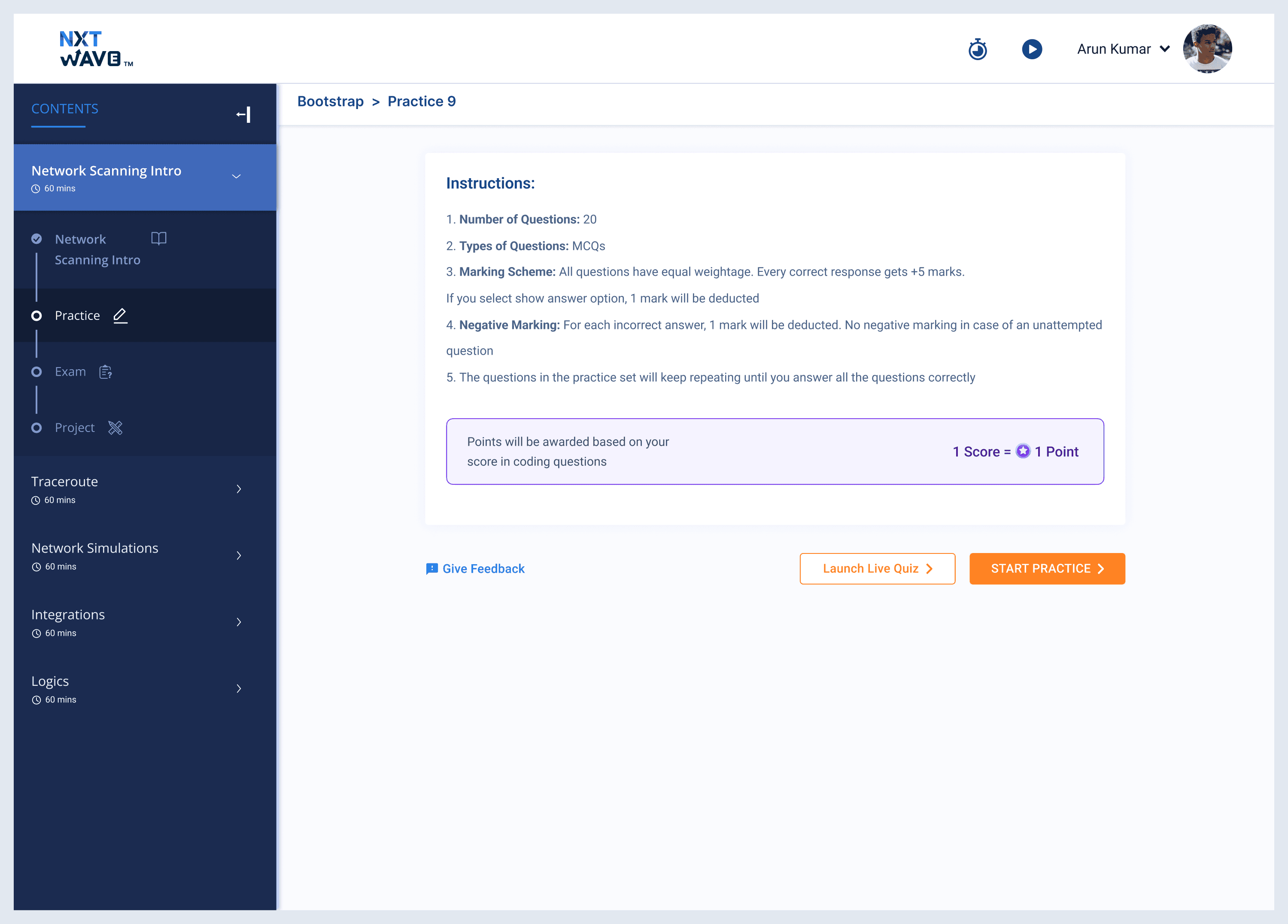
There is no separate admin panel. No "live mode" detour. The live quiz lives inside the same unit the instructor was about to teach anyway.
There is no separate admin panel. No "live mode" detour. The live quiz lives inside the same unit the instructor was about to teach anyway.
There is no separate admin panel. No "live mode" detour. The live quiz lives inside the same unit the instructor was about to teach anyway.
When the instructor clicks Launch Live Quiz, a session code appears. Six characters. Projected on the LCDs at the front of the classroom. The students type those six characters into their laptops and join.
When the instructor clicks Launch Live Quiz, a session code appears. Six characters. Projected on the LCDs at the front of the classroom. The students type those six characters into their laptops and join.
When the instructor clicks Launch Live Quiz, a session code appears. Six characters. Projected on the LCDs at the front of the classroom. The students type those six characters into their laptops and join.
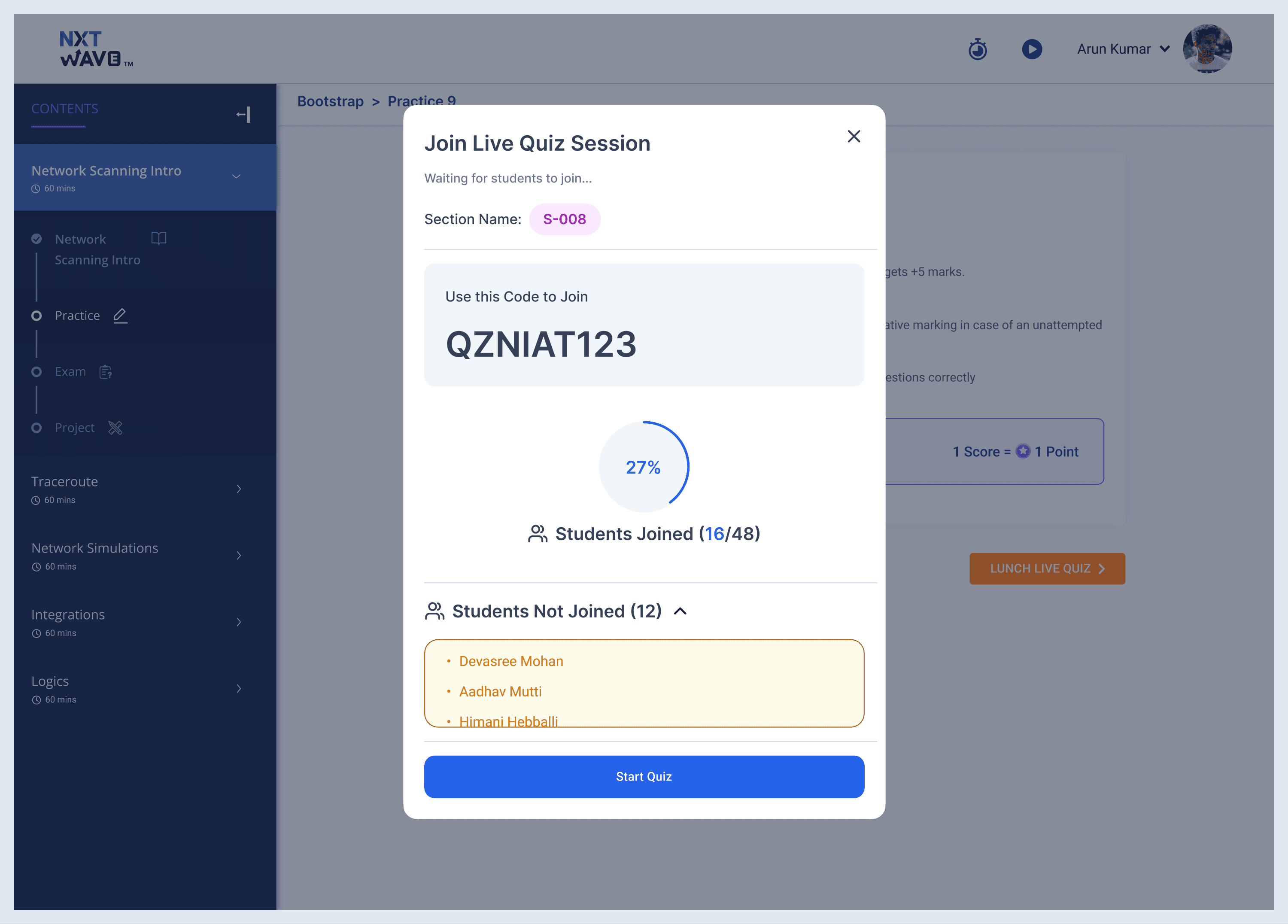
The section name is shown at the top of the modal. This sounds trivial. It isn't. Instructors at NIAT often teach the same unit to multiple sections in a day. Showing the section name prevents launching the wrong session for the wrong batch.
The section name is shown at the top of the modal. This sounds trivial. It isn't. Instructors at NIAT often teach the same unit to multiple sections in a day. Showing the section name prevents launching the wrong session for the wrong batch.
The section name is shown at the top of the modal. This sounds trivial. It isn't. Instructors at NIAT often teach the same unit to multiple sections in a day. Showing the section name prevents launching the wrong session for the wrong batch.
Instructor research kept surfacing the same request. Can I see who hasn't joined yet? The Students Not Joined dropdown answers it.
Instructor research kept surfacing the same request. Can I see who hasn't joined yet? The Students Not Joined dropdown answers it.
Instructor research kept surfacing the same request. Can I see who hasn't joined yet? The Students Not Joined dropdown answers it.
Targeted nudges instead of broadcast pleas. Saves about ninety seconds per session and keeps the energy from deflating during the wait.
Targeted nudges instead of broadcast pleas. Saves about ninety seconds per session and keeps the energy from deflating during the wait.
Targeted nudges instead of broadcast pleas. Saves about ninety seconds per session and keeps the energy from deflating during the wait.
Once the quiz begins, the instructor's view is dominated by a participation counter at the bottom of the question.
Once the quiz begins, the instructor's view is dominated by a participation counter at the bottom of the question.
Once the quiz begins, the instructor's view is dominated by a participation counter at the bottom of the question.
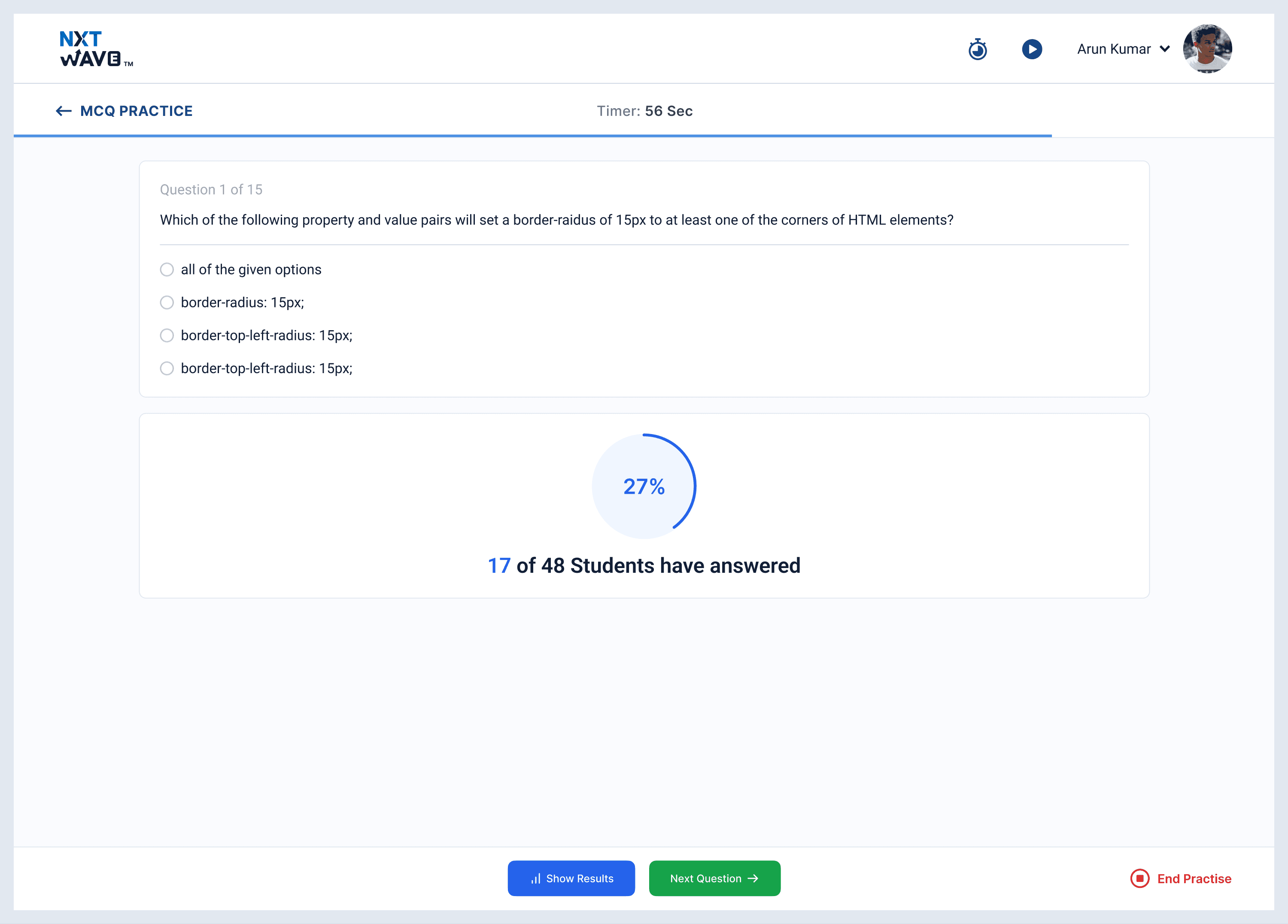
The controls — Show Results and Next Question — sit deliberately at the bottom of the screen. The projector is showing this exact view to the entire classroom. We didn't want the mouse cursor hovering over action buttons in the upper third of a 75-inch LCD. Small choice. Visible to forty-eight students simultaneously.
The controls — Show Results and Next Question — sit deliberately at the bottom of the screen. The projector is showing this exact view to the entire classroom. We didn't want the mouse cursor hovering over action buttons in the upper third of a 75-inch LCD. Small choice. Visible to forty-eight students simultaneously.
The controls — Show Results and Next Question — sit deliberately at the bottom of the screen. The projector is showing this exact view to the entire classroom. We didn't want the mouse cursor hovering over action buttons in the upper third of a 75-inch LCD. Small choice. Visible to forty-eight students simultaneously.
And then there is the screen that, in our view, is the single most pedagogically valuable surface in the entire feature.
And then there is the screen that, in our view, is the single most pedagogically valuable surface in the entire feature.
And then there is the screen that, in our view, is the single most pedagogically valuable surface in the entire feature.
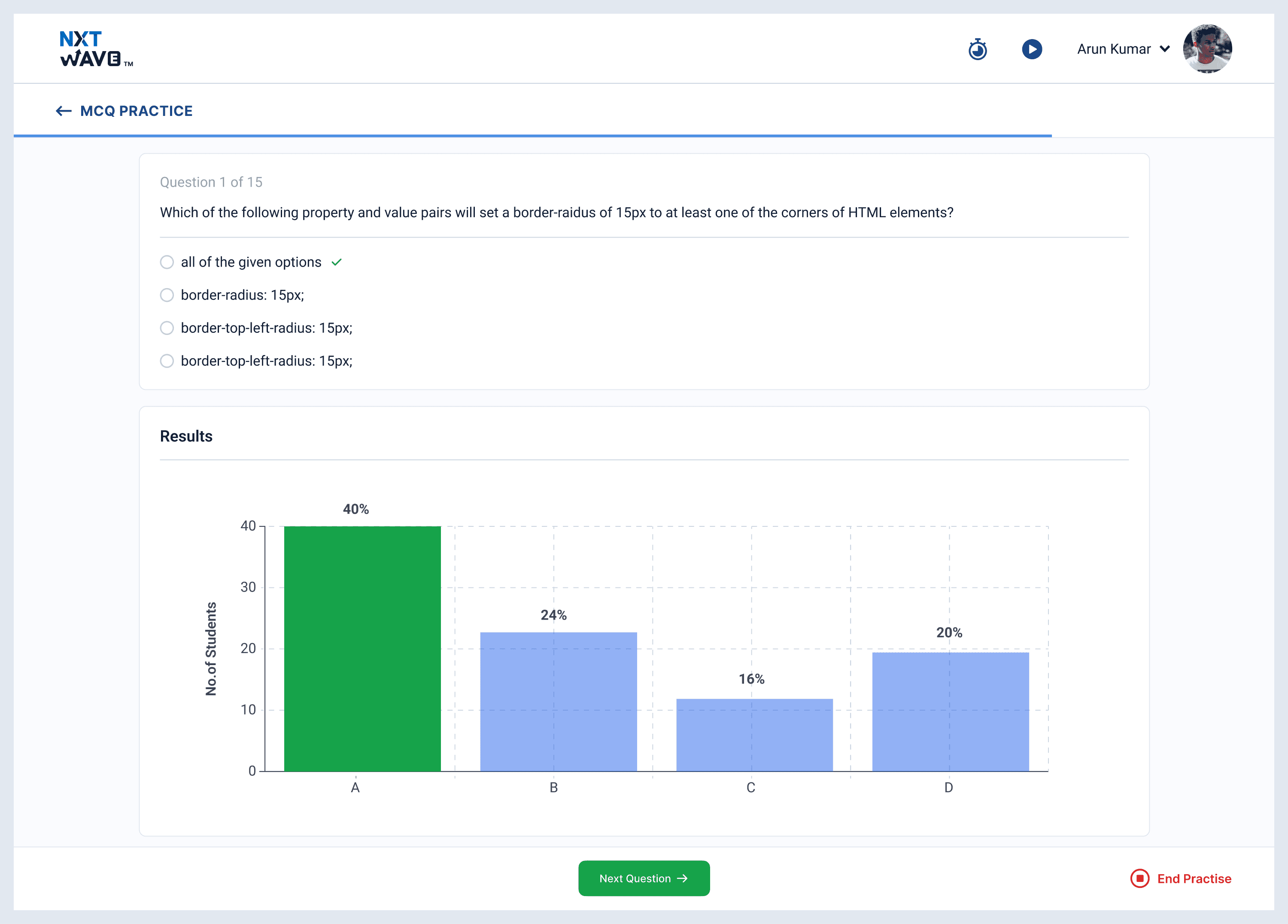
The instructor no longer asks "any doubts?" They say: everyone who picked B — let me show you why that's a tempting answer but actually wrong.
The instructor no longer asks "any doubts?" They say: everyone who picked B — let me show you why that's a tempting answer but actually wrong.
The instructor no longer asks "any doubts?" They say: everyone who picked B — let me show you why that's a tempting answer but actually wrong.
Notice the social shift. The instructor addresses the misconception, not the people. Students who picked B don't have to admit it. They just listen. Pluralistic ignorance, broken in thirty seconds.
Notice the social shift. The instructor addresses the misconception, not the people. Students who picked B don't have to admit it. They just listen. Pluralistic ignorance, broken in thirty seconds.
Notice the social shift. The instructor addresses the misconception, not the people. Students who picked B don't have to admit it. They just listen. Pluralistic ignorance, broken in thirty seconds.
When the last question is done, the instructor lands on the session summary.
When the last question is done, the instructor lands on the session summary.
When the last question is done, the instructor lands on the session summary.
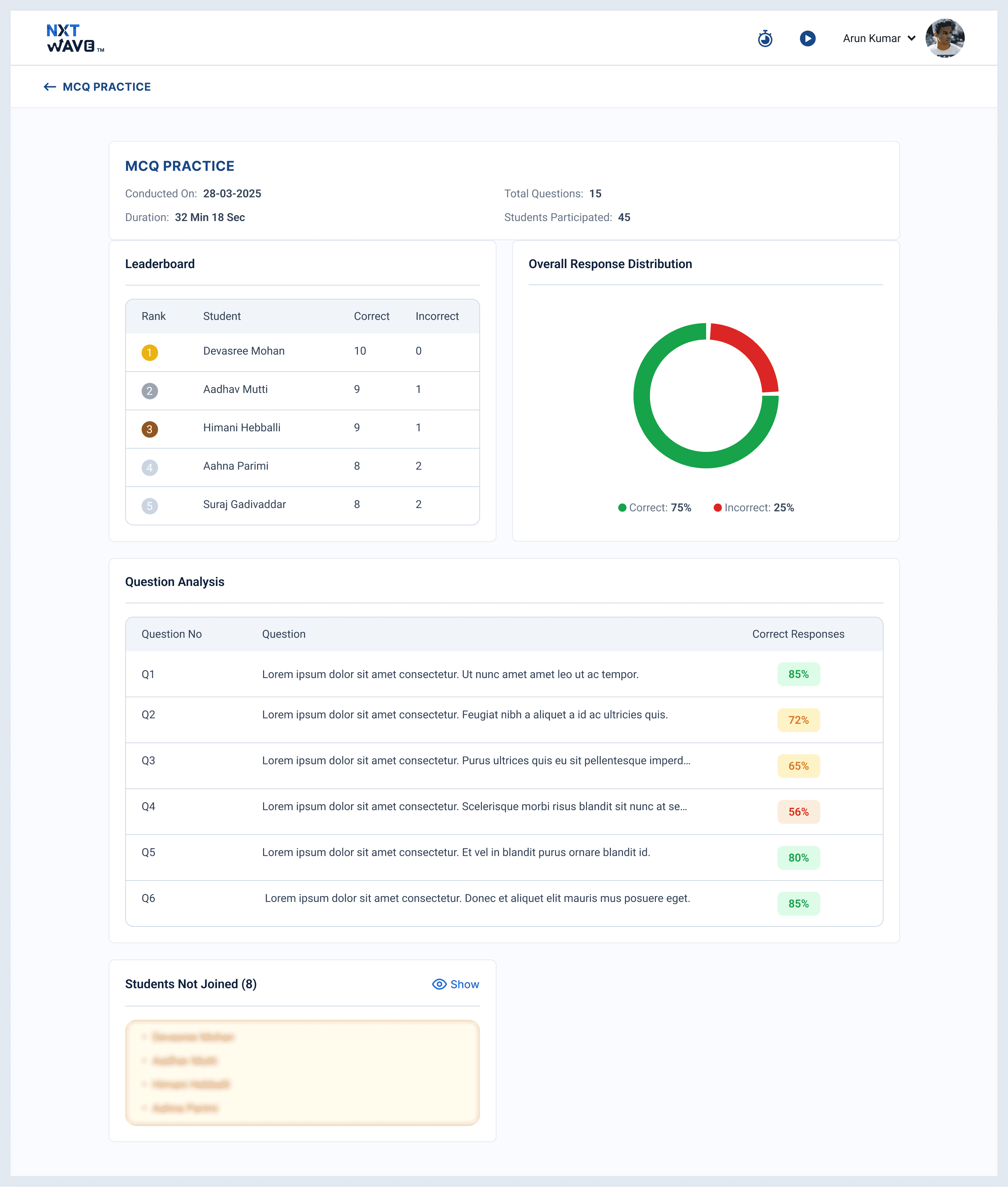
Three intentional choices on this screen. The leaderboard shows top five only — gold, silver, bronze for ranks one through three. The bottom of the table is not shown publicly. The question analysis colour-codes each question by percentage correct: green if at least 80%, yellow between 60 and 80, red below. The instructor knows at a glance what to revisit next class. And Students Not Joined is collapsed by default — visible for follow-up, not the headline of the screen.
Three intentional choices on this screen. The leaderboard shows top five only — gold, silver, bronze for ranks one through three. The bottom of the table is not shown publicly. The question analysis colour-codes each question by percentage correct: green if at least 80%, yellow between 60 and 80, red below. The instructor knows at a glance what to revisit next class. And Students Not Joined is collapsed by default — visible for follow-up, not the headline of the screen.
Three intentional choices on this screen. The leaderboard shows top five only — gold, silver, bronze for ranks one through three. The bottom of the table is not shown publicly. The question analysis colour-codes each question by percentage correct: green if at least 80%, yellow between 60 and 80, red below. The instructor knows at a glance what to revisit next class. And Students Not Joined is collapsed by default — visible for follow-up, not the headline of the screen.
The Student's Side of the Room
The Student's Side of the Room
The Student's Side of the Room
The student's journey runs in lockstep with the instructor's. But the screens are tuned for a different goal: make participation effortless, then make the result feel meaningful.
The student's journey runs in lockstep with the instructor's. But the screens are tuned for a different goal: make participation effortless, then make the result feel meaningful.
The student's journey runs in lockstep with the instructor's. But the screens are tuned for a different goal: make participation effortless, then make the result feel meaningful.
Joining is six characters typed into a laptop.
Joining is six characters typed into a laptop.
Joining is six characters typed into a laptop.
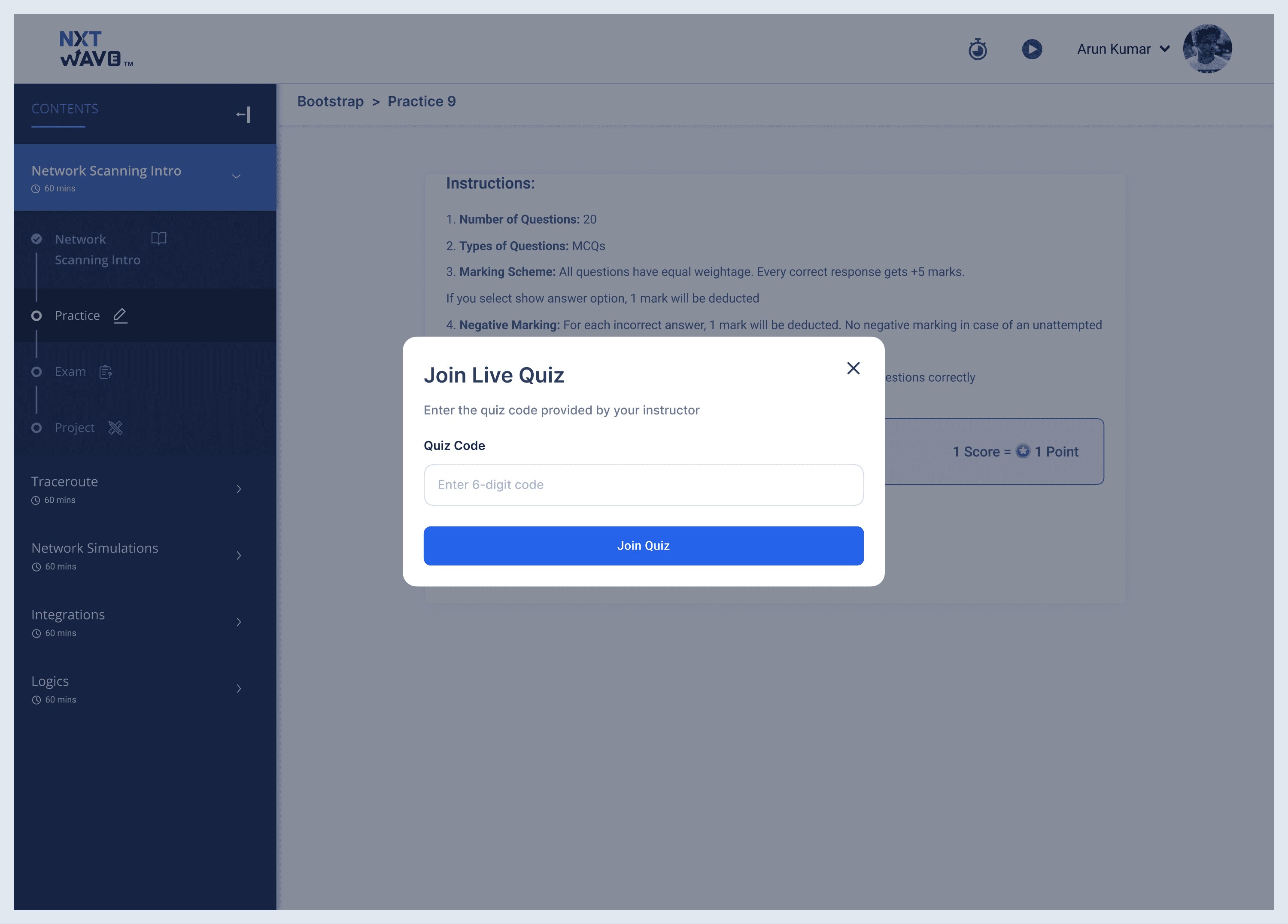
We considered QR codes early. We dropped them. Every student is already on a laptop with the platform open, and asking them to switch to a phone for a short exercise inside a single class adds friction with zero benefit. A six-character code typed into the same browser tab they were already using turned out to be the simplest, most reliable join we could design.
We considered QR codes early. We dropped them. Every student is already on a laptop with the platform open, and asking them to switch to a phone for a short exercise inside a single class adds friction with zero benefit. A six-character code typed into the same browser tab they were already using turned out to be the simplest, most reliable join we could design.
We considered QR codes early. We dropped them. Every student is already on a laptop with the platform open, and asking them to switch to a phone for a short exercise inside a single class adds friction with zero benefit. A six-character code typed into the same browser tab they were already using turned out to be the simplest, most reliable join we could design.
After joining, the student sees a holding screen until the instructor starts the quiz.
After joining, the student sees a holding screen until the instructor starts the quiz.
After joining, the student sees a holding screen until the instructor starts the quiz.
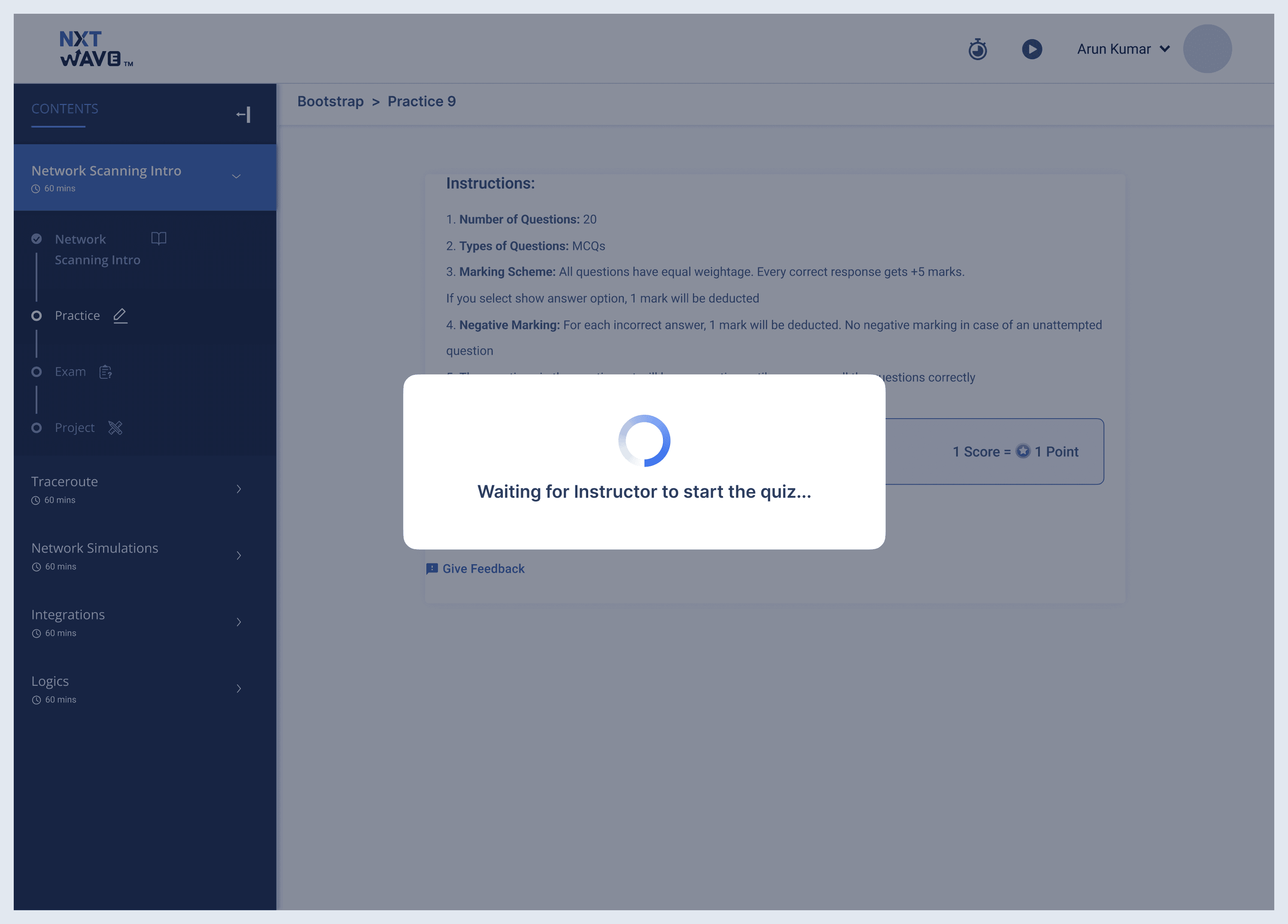
We resisted filling this screen with tips, ads, or motivational quotes. The student is in a physical classroom with an instructor talking. The wait state should not compete for attention. It should just confirm: you're in.
We resisted filling this screen with tips, ads, or motivational quotes. The student is in a physical classroom with an instructor talking. The wait state should not compete for attention. It should just confirm: you're in.
We resisted filling this screen with tips, ads, or motivational quotes. The student is in a physical classroom with an instructor talking. The wait state should not compete for attention. It should just confirm: you're in.
When the quiz begins, the student sees a screen that looks deliberately, almost boringly, like the Practice MCQ they already use every day.
When the quiz begins, the student sees a screen that looks deliberately, almost boringly, like the Practice MCQ they already use every day.
When the quiz begins, the student sees a screen that looks deliberately, almost boringly, like the Practice MCQ they already use every day.
Same format. Same submit button. Zero new mental model.
Same format. Same submit button. Zero new mental model.
Same format. Same submit button. Zero new mental model.
The synchronised wait after submission is doing more work than it looks like.
The synchronised wait after submission is doing more work than it looks like.
The synchronised wait after submission is doing more work than it looks like.
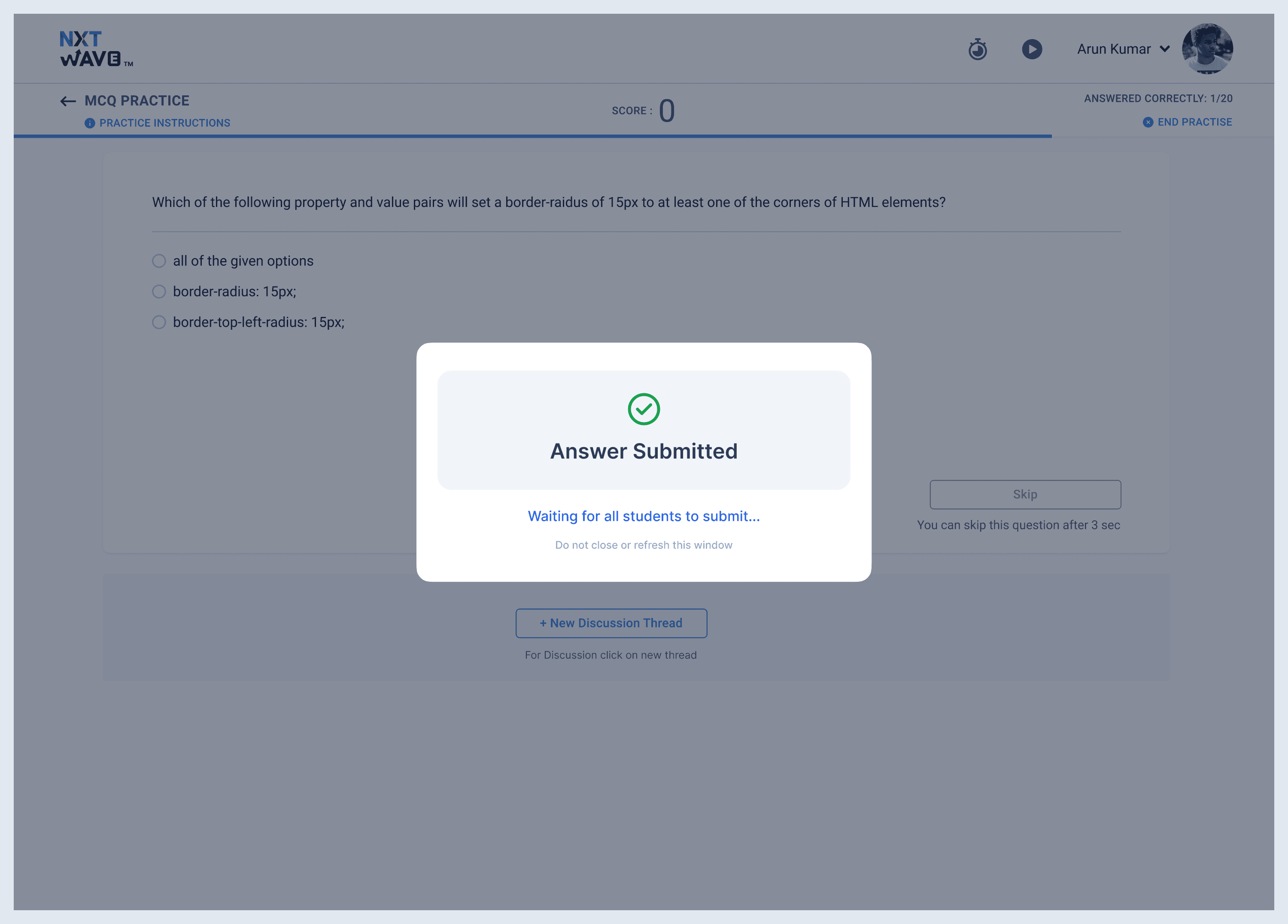
Several jobs in one screen. Confirm the submission. Set the expectation. Prevent premature exit. And — most importantly — don't show early-finishers the result yet. Their best use of those thirty seconds is listening to the instructor explain the question, not staring at a leaderboard.
Several jobs in one screen. Confirm the submission. Set the expectation. Prevent premature exit. And — most importantly — don't show early-finishers the result yet. Their best use of those thirty seconds is listening to the instructor explain the question, not staring at a leaderboard.
Several jobs in one screen. Confirm the submission. Set the expectation. Prevent premature exit. And — most importantly — don't show early-finishers the result yet. Their best use of those thirty seconds is listening to the instructor explain the question, not staring at a leaderboard.
When the quiz ends, students don't get a clinical results table. They get one of three differentiated celebration screens, depending on how they performed.
When the quiz ends, students don't get a clinical results table. They get one of three differentiated celebration screens, depending on how they performed.
When the quiz ends, students don't get a clinical results table. They get one of three differentiated celebration screens, depending on how they performed.
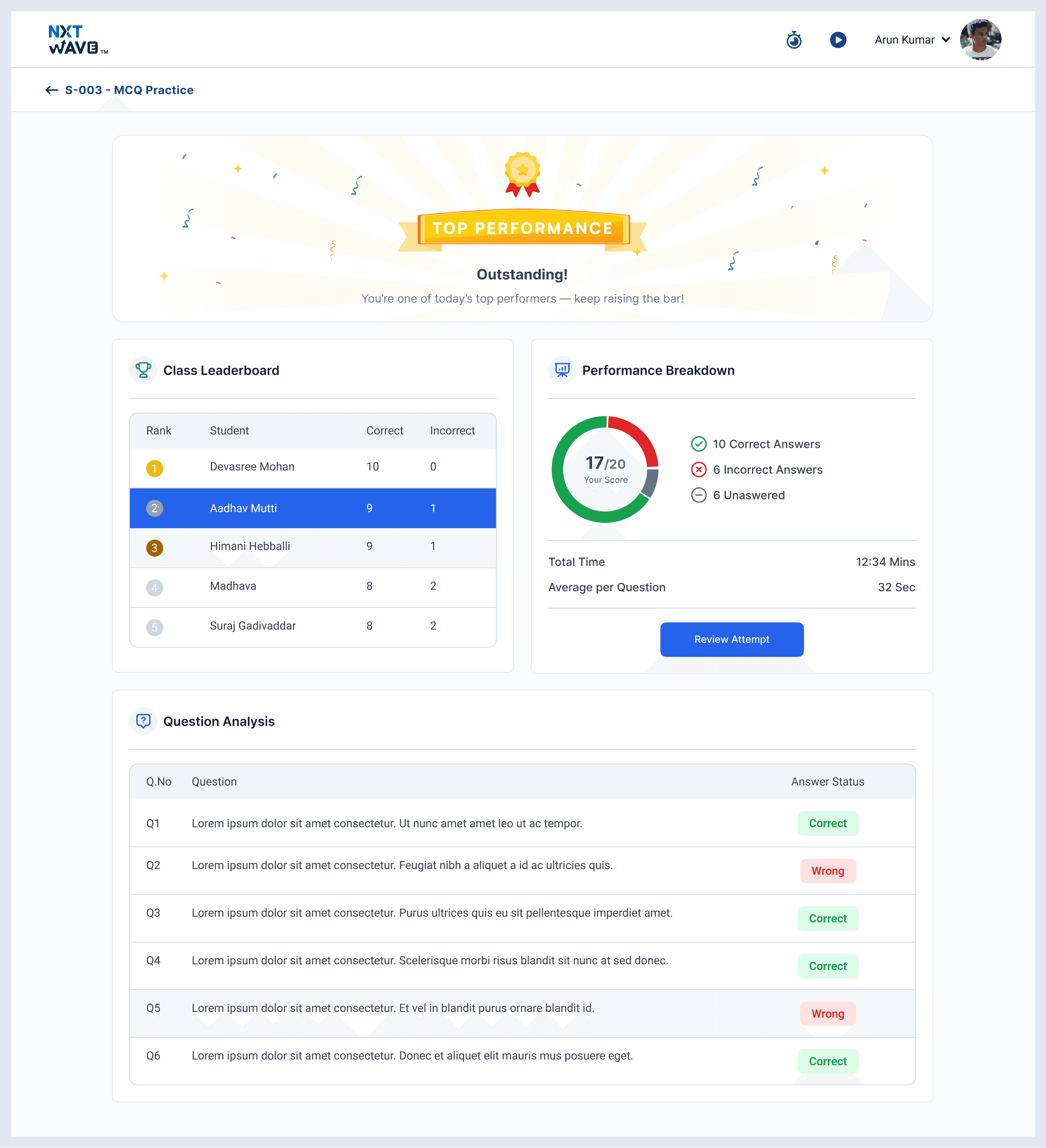
The differentiation matters. One celebration for everyone is meaningless. A celebration only for the top five makes the rest invisible. The Growth Zone screen acknowledges effort honestly — you didn't win this one, here's where to push next — while pointing at the gap.
The differentiation matters. One celebration for everyone is meaningless. A celebration only for the top five makes the rest invisible. The Growth Zone screen acknowledges effort honestly — you didn't win this one, here's where to push next — while pointing at the gap.
The differentiation matters. One celebration for everyone is meaningless. A celebration only for the top five makes the rest invisible. The Growth Zone screen acknowledges effort honestly — you didn't win this one, here's where to push next — while pointing at the gap.
The Synchronisation Problem Underneath It All
The Synchronisation Problem Underneath It All
The Synchronisation Problem Underneath It All
The hardest engineering problem was synchronisation. A live quiz is only "live" if forty-eight laptops display the same question at the same instant.
The hardest engineering problem was synchronisation. A live quiz is only "live" if forty-eight laptops display the same question at the same instant.
The hardest engineering problem was synchronisation. A live quiz is only "live" if forty-eight laptops display the same question at the same instant.
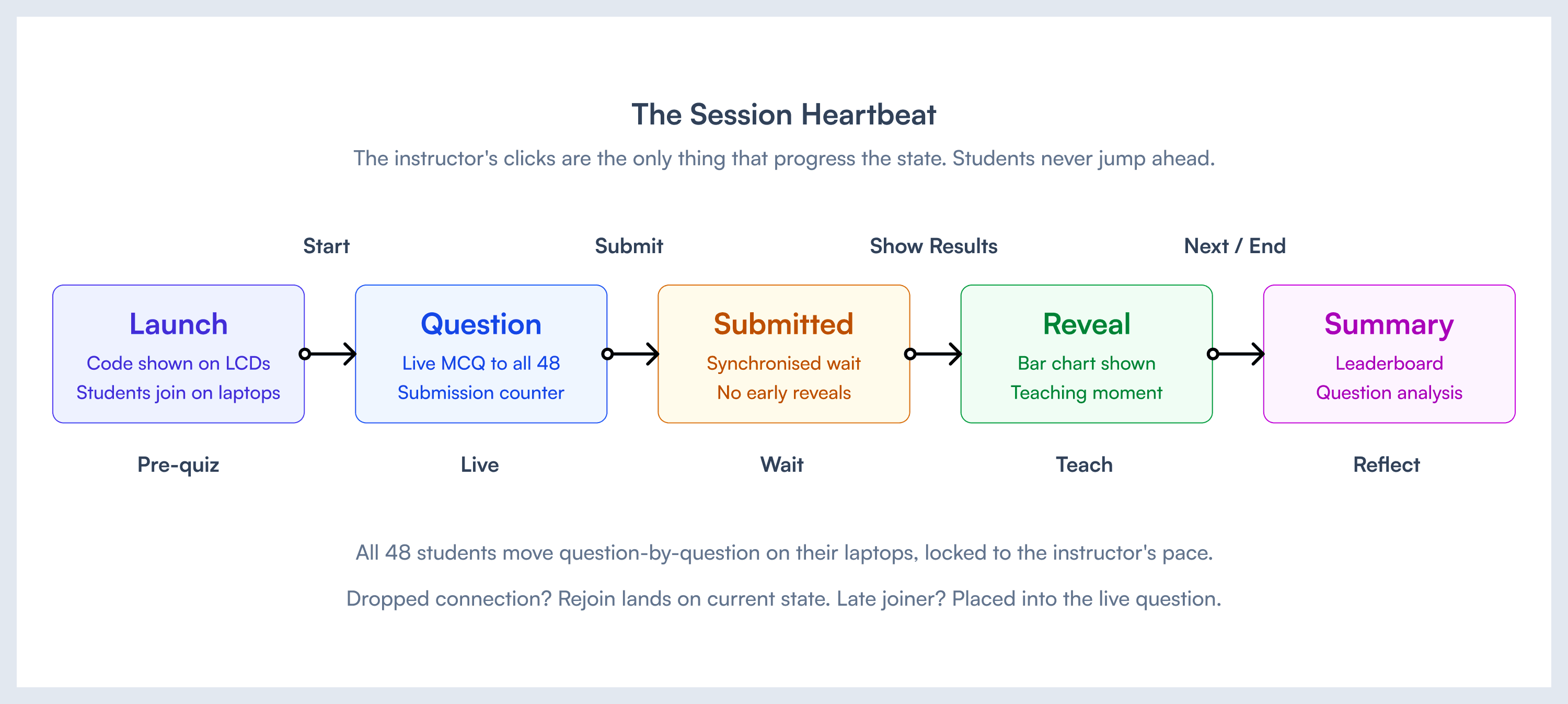
The instructor's clicks are the only thing that progress the state. Students never see the next question until the instructor moves the room forward. The system gracefully handles dropped connections, late joiners who walk in mid-quiz, and accidental "End Practise" clicks. The architecture sounds simple. It isn't.
The instructor's clicks are the only thing that progress the state. Students never see the next question until the instructor moves the room forward. The system gracefully handles dropped connections, late joiners who walk in mid-quiz, and accidental "End Practise" clicks. The architecture sounds simple. It isn't.
The instructor's clicks are the only thing that progress the state. Students never see the next question until the instructor moves the room forward. The system gracefully handles dropped connections, late joiners who walk in mid-quiz, and accidental "End Practise" clicks. The architecture sounds simple. It isn't.
The Analytics Layer
The Analytics Layer
The Analytics Layer
Running the quiz is half the product. The other half is what we do with the data afterwards.
Running the quiz is half the product. The other half is what we do with the data afterwards.
Running the quiz is half the product. The other half is what we do with the data afterwards.
We track two broad categories. Attendance and participation — total joined, join trend minute by minute, average attendance duration, drop-off curve, device split, network quality split. Engagement — chat participation, hand-raise events, reactions, quiz open versus submit rate.
We track two broad categories. Attendance and participation — total joined, join trend minute by minute, average attendance duration, drop-off curve, device split, network quality split. Engagement — chat participation, hand-raise events, reactions, quiz open versus submit rate.
We track two broad categories. Attendance and participation — total joined, join trend minute by minute, average attendance duration, drop-off curve, device split, network quality split. Engagement — chat participation, hand-raise events, reactions, quiz open versus submit rate.
These same metrics get rendered differently for three different audiences. And that is where the data starts compounding into real institutional intelligence.
These same metrics get rendered differently for three different audiences. And that is where the data starts compounding into real institutional intelligence.
These same metrics get rendered differently for three different audiences. And that is where the data starts compounding into real institutional intelligence.
The student sees a personal lens — accuracy trend, topic mastery, where they are lagging. The instructor sees a sectional lens — per-question confusions, section-versus-section comparisons over time, topics to repeat next class. Leadership sees an institutional lens — cross-campus pass rates, instructor coaching signals, curriculum-level outcome trends.
The student sees a personal lens — accuracy trend, topic mastery, where they are lagging. The instructor sees a sectional lens — per-question confusions, section-versus-section comparisons over time, topics to repeat next class. Leadership sees an institutional lens — cross-campus pass rates, instructor coaching signals, curriculum-level outcome trends.
The student sees a personal lens — accuracy trend, topic mastery, where they are lagging. The instructor sees a sectional lens — per-question confusions, section-versus-section comparisons over time, topics to repeat next class. Leadership sees an institutional lens — cross-campus pass rates, instructor coaching signals, curriculum-level outcome trends.
Same data. Three audiences. Three different decisions made from it.
Same data. Three audiences. Three different decisions made from it.
Same data. Three audiences. Three different decisions made from it.
What the Data Says Now
What the Data Says Now
What the Data Says Now
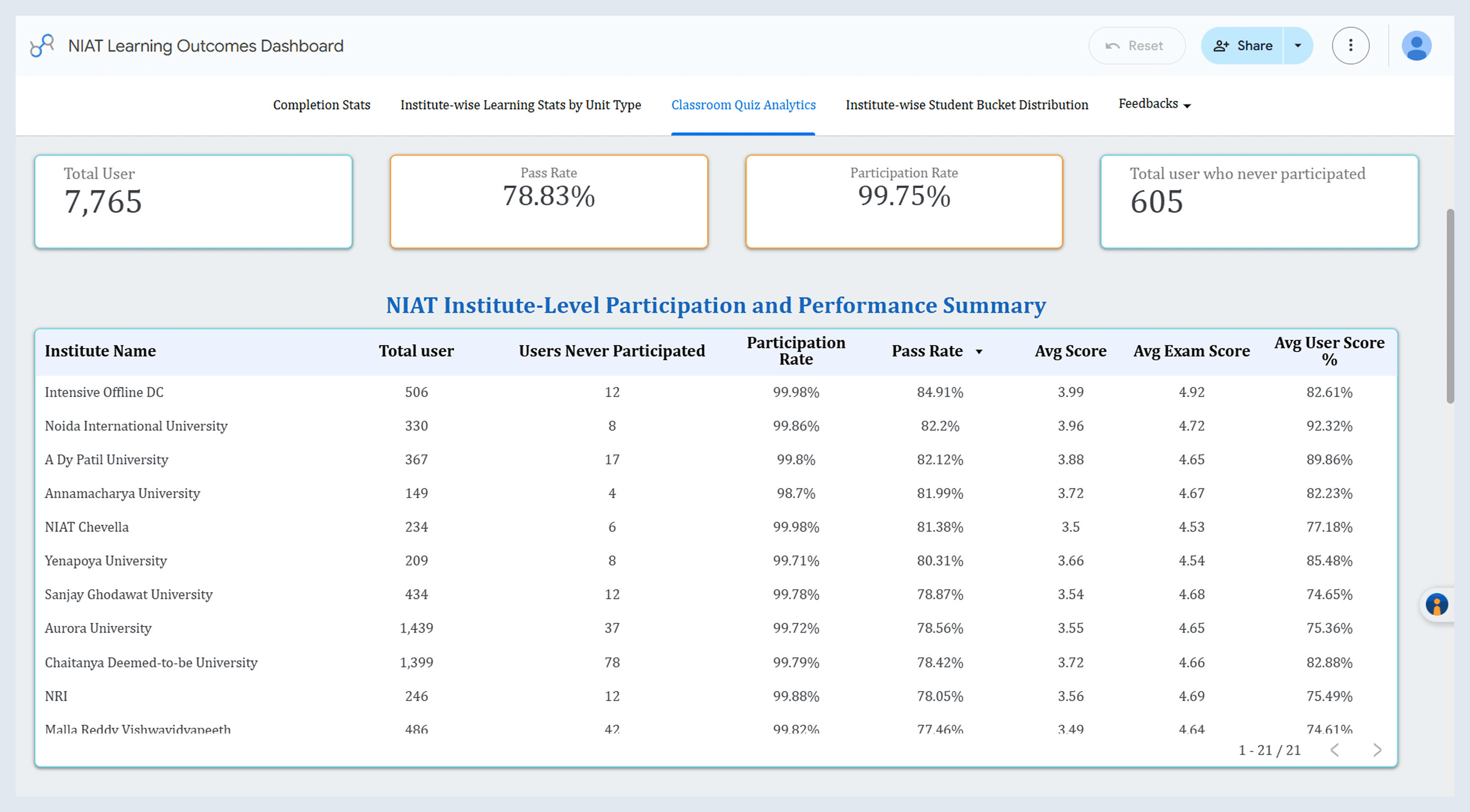
The dashboard below is not a baseline. It's the post-launch state — what classroom learning looks like today, with the live quiz running across more than twenty campuses.
The dashboard below is not a baseline. It's the post-launch state — what classroom learning looks like today, with the live quiz running across more than twenty campuses.
The dashboard below is not a baseline. It's the post-launch state — what classroom learning looks like today, with the live quiz running across more than twenty campuses.
A few signals are worth pointing at directly.
A few signals are worth pointing at directly.
A few signals are worth pointing at directly.
Participation rate sits at 99.75% across nearly eight thousand active users. The live format pulled the long tail of disengaged students into the room. Average pass rate is 78.84% with a healthy spread — 70% to 82% across institutes. The spread itself is now a usable diagnostic. Institutes at the lower end can be coached using sectional data we never had before. User Score % ranges from 68.89% to 92.32% across institutes on identical curriculum. Pre-launch, this gap was invisible until the weekly tests ran. Post-launch, instructors see it within minutes of the class ending.
Participation rate sits at 99.75% across nearly eight thousand active users. The live format pulled the long tail of disengaged students into the room. Average pass rate is 78.84% with a healthy spread — 70% to 82% across institutes. The spread itself is now a usable diagnostic. Institutes at the lower end can be coached using sectional data we never had before. User Score % ranges from 68.89% to 92.32% across institutes on identical curriculum. Pre-launch, this gap was invisible until the weekly tests ran. Post-launch, instructors see it within minutes of the class ending.
Participation rate sits at 99.75% across nearly eight thousand active users. The live format pulled the long tail of disengaged students into the room. Average pass rate is 78.84% with a healthy spread — 70% to 82% across institutes. The spread itself is now a usable diagnostic. Institutes at the lower end can be coached using sectional data we never had before. User Score % ranges from 68.89% to 92.32% across institutes on identical curriculum. Pre-launch, this gap was invisible until the weekly tests ran. Post-launch, instructors see it within minutes of the class ending.
The mechanism behind the impact is structural. A typical student's post-class loop looks different now.
The mechanism behind the impact is structural. A typical student's post-class loop looks different now.
The mechanism behind the impact is structural. A typical student's post-class loop looks different now.
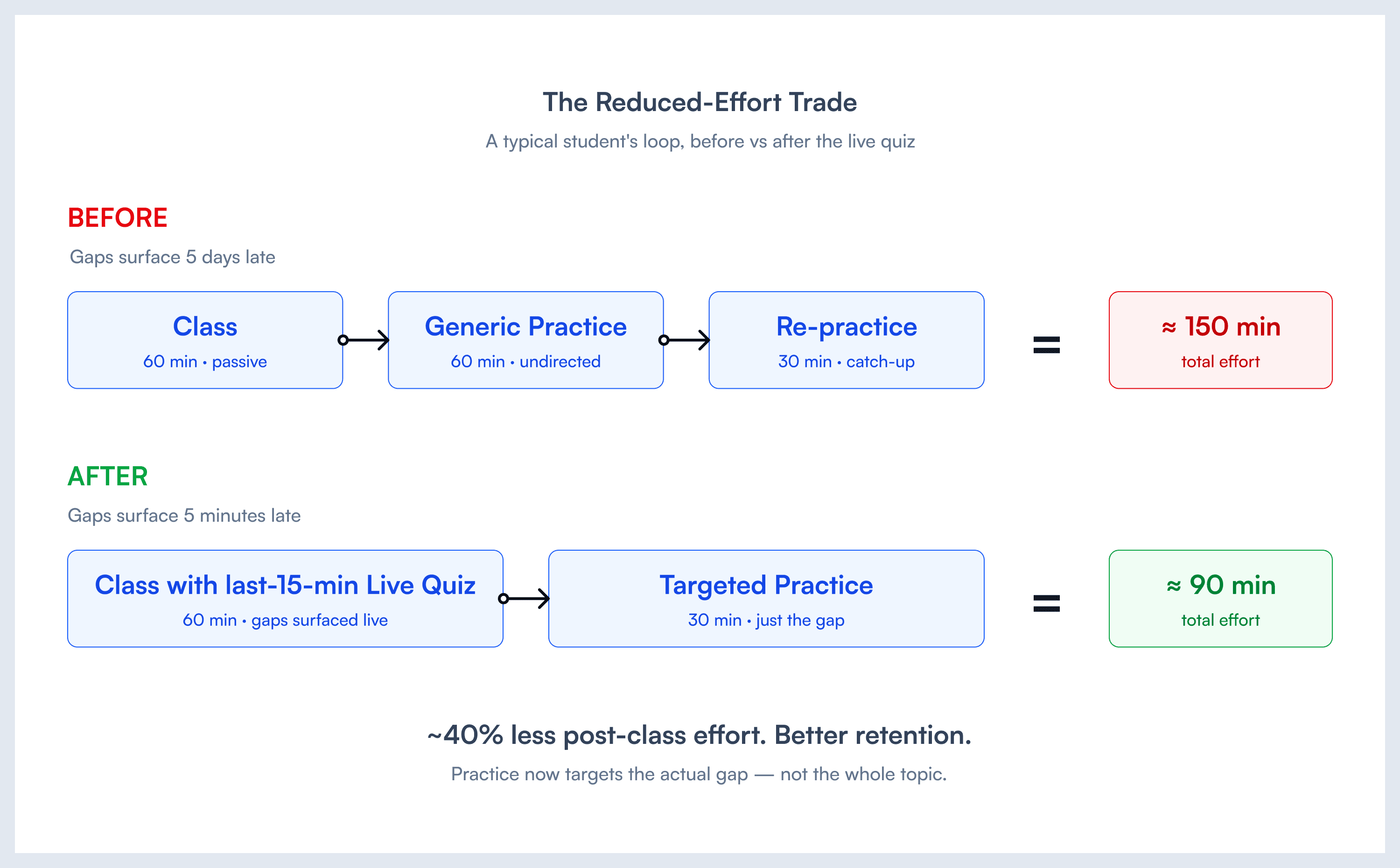
Less time on undirected practice. More time spent on the gaps the live quiz surfaced minutes after the class ended — long before the weekly assessment ever arrived.
Less time on undirected practice. More time spent on the gaps the live quiz surfaced minutes after the class ended — long before the weekly assessment ever arrived.
Less time on undirected practice. More time spent on the gaps the live quiz surfaced minutes after the class ended — long before the weekly assessment ever arrived.
Closing Thought
Closing Thought
Closing Thought
The student we designed this feature for is the one who never raises her hand.
The student we designed this feature for is the one who never raises her hand.
The student we designed this feature for is the one who never raises her hand.
She isn't at the top of the leaderboard. She isn't at the bottom either. She sits two-thirds of the way back, takes notes, doesn't ask questions, and quietly carries her doubts home with her every evening — until they decay into a fuzzy "I don't really remember" by the time the weekly assessment arrives.
She isn't at the top of the leaderboard. She isn't at the bottom either. She sits two-thirds of the way back, takes notes, doesn't ask questions, and quietly carries her doubts home with her every evening — until they decay into a fuzzy "I don't really remember" by the time the weekly assessment arrives.
She isn't at the top of the leaderboard. She isn't at the bottom either. She sits two-thirds of the way back, takes notes, doesn't ask questions, and quietly carries her doubts home with her every evening — until they decay into a fuzzy "I don't really remember" by the time the weekly assessment arrives.
That was the student we'd been losing. Not in any dramatic way. Just in tiny daily increments. A confused minute here. A skipped doubt there. A weekly test that revealed a gap from a class six days ago.
That was the student we'd been losing. Not in any dramatic way. Just in tiny daily increments. A confused minute here. A skipped doubt there. A weekly test that revealed a gap from a class six days ago.
That was the student we'd been losing. Not in any dramatic way. Just in tiny daily increments. A confused minute here. A skipped doubt there. A weekly test that revealed a gap from a class six days ago.
The Live Quiz tool isn't flashy. It's two buttons — Launch Live Quiz on the instructor's side, Join Live Quiz on the student's side — wired into the curriculum that was already there.
The Live Quiz tool isn't flashy. It's two buttons — Launch Live Quiz on the instructor's side, Join Live Quiz on the student's side — wired into the curriculum that was already there.
The Live Quiz tool isn't flashy. It's two buttons — Launch Live Quiz on the instructor's side, Join Live Quiz on the student's side — wired into the curriculum that was already there.
But sitting behind those buttons is a small philosophical shift in how a classroom works.
But sitting behind those buttons is a small philosophical shift in how a classroom works.
But sitting behind those buttons is a small philosophical shift in how a classroom works.
The signal that a student is struggling shouldn't arrive five days late. It should arrive five minutes late.
The signal that a student is struggling shouldn't arrive five days late. It should arrive five minutes late.
The signal that a student is struggling shouldn't arrive five days late. It should arrive five minutes late.
If we get that right, the closing stretch of every class becomes the moment the entire week pivots on. That's the bet.
If we get that right, the closing stretch of every class becomes the moment the entire week pivots on. That's the bet.
If we get that right, the closing stretch of every class becomes the moment the entire week pivots on. That's the bet.
Want to work together?
Feel free to reach out for collaborations, inquiries, or just to say hello.
Want to work together?
Feel free to reach out for collaborations, inquiries, or just to say hello.
Want to work together?
Feel free to reach out for collaborations, inquiries, or just to say hello.
Let's Be Friends
Feel Free to Hit Me Up!
I always enjoyed product discussions and If you’re a startup founder or PM/Growth person and interested to chat! Hit me up on any social media platforms.






Crafted with ❤️ on Framer, All Rights Reserved © 2026 Guruprakash.
Let's Be Friends
Feel Free to Hit Me Up!
I always enjoyed product discussions and If you’re a startup founder or PM/Growth person and interested to chat! Hit me up on any social media platforms.
Crafted with ❤️ on Framer, All Rights Reserved © 2025 Guruprakash.
Let's Be Friends
Feel Free to Hit Me Up!
I always enjoyed product discussions and If you’re a startup founder or PM/Growth person and interested to chat! Hit me up on any social media platforms.
Crafted with ❤️ on Framer
All Rights Reserved © 2025 Guruprakash.